Microsoft announced a suite of new AI models and devices at its Build 2026 developer conference in San Francisco on June 2, 2026, marking a shift toward self-developed AI to cut dependence on external providers like OpenAI and Anthropic [1, 2, 3, 4, 5].
The company introduced MAI-Thinking-1, a reasoning AI model with 35 billion parameters and a 128,000 token context window, built from scratch without distillation. Kyle Daigle, Microsoft Developer Marketing Chief, described it as "medium-sized, built for high efficiency and performance, but importantly, at a low-token cost," aimed at reducing developers’ costs [2, 3, 6, 5].
Alongside this, Microsoft launched MAI-Code-1, an AI coding model that generates source code from natural language prompts. This model is integrated into GitHub Copilot and Visual Studio Code to assist developers with programming tasks [1, 2, 6, 5].
The new MAI model family covers seven core AI areas including reasoning, image generation, speech transcription, voice synthesis, and code generation. The focus is on high efficiency, high performance, and low token costs to empower developers with more control and reduce reliance on third-party models [3, 7, 8, 5, 9].
Microsoft said its AI strategy targets enterprise customers with autonomous AI applications, competing mainly with Anthropic in this space. Mustafa Suleyman, Microsoft AI chief, stated, "We are more focused on the Anthropic-style route, enterprise applications, developers, and programming. That is the direction we've been going" [3].
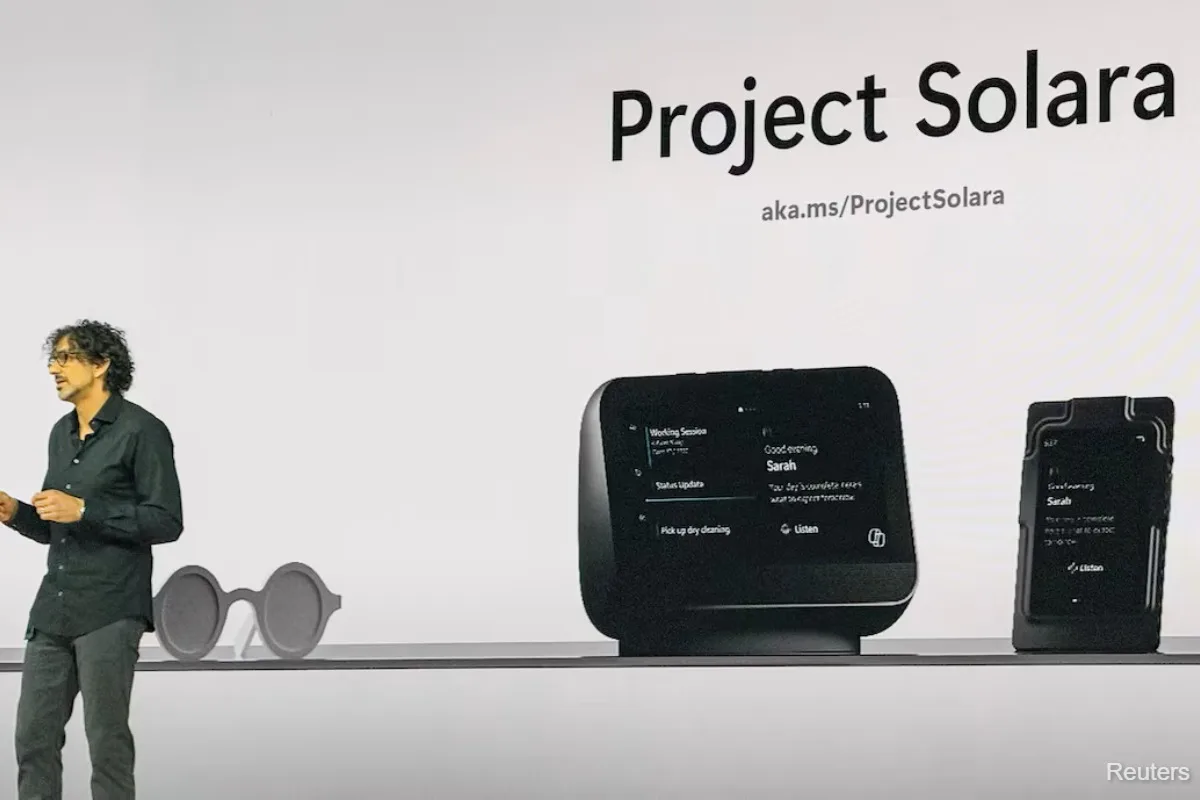
On the hardware side, Microsoft revealed Project Solara, a series of AI agent-hosting prototypes in smart speaker and badge form factors built using Qualcomm and MediaTek chips. CEO Satya Nadella commented, "Whenever these new platforms come, you get to rewrite even the rules of how new platforms operate. That's what we're trying to get done with Project Solara..." [1, 4].
The company also showcased the Surface RTX Spark Dev Box, an AI-focused PC equipped with an Nvidia RTX Spark chip that can run very large AI models locally, up to 1.2 trillion parameters [1, 4, 7, 5]. Peter Steinberger, inventor of OpenClaw, noted, "Now you can run OpenClaw fully within the company," highlighting the device’s local AI processing power [4].
Microsoft introduced Microsoft Scout, a proactive AI personal assistant currently in limited preview that automates meetings, schedule management, and email drafting without user prompts [7, 8, 5, 9].
Microsoft emphasizes an open, heterogeneous AI stack providing model choices and governance across chipsets, operating systems, cloud, and developer tools, with Windows as a key platform. The company has invested about $13 billion in OpenAI and $5 billion in Anthropic but aims to reduce its dependence on those external AI models by building its own stack [10, 2, 3, 6, 9].
The Build 2026 event marked a clear step toward AI autonomy in enterprise applications with a full ecosystem of models, devices, and developer tools designed to empower innovation on Microsoft’s platform [1, 2, 3, 4, 5]. The next phase will be expanding the availability of the new MAI models and hardware to developers and enterprise customers in the coming months.