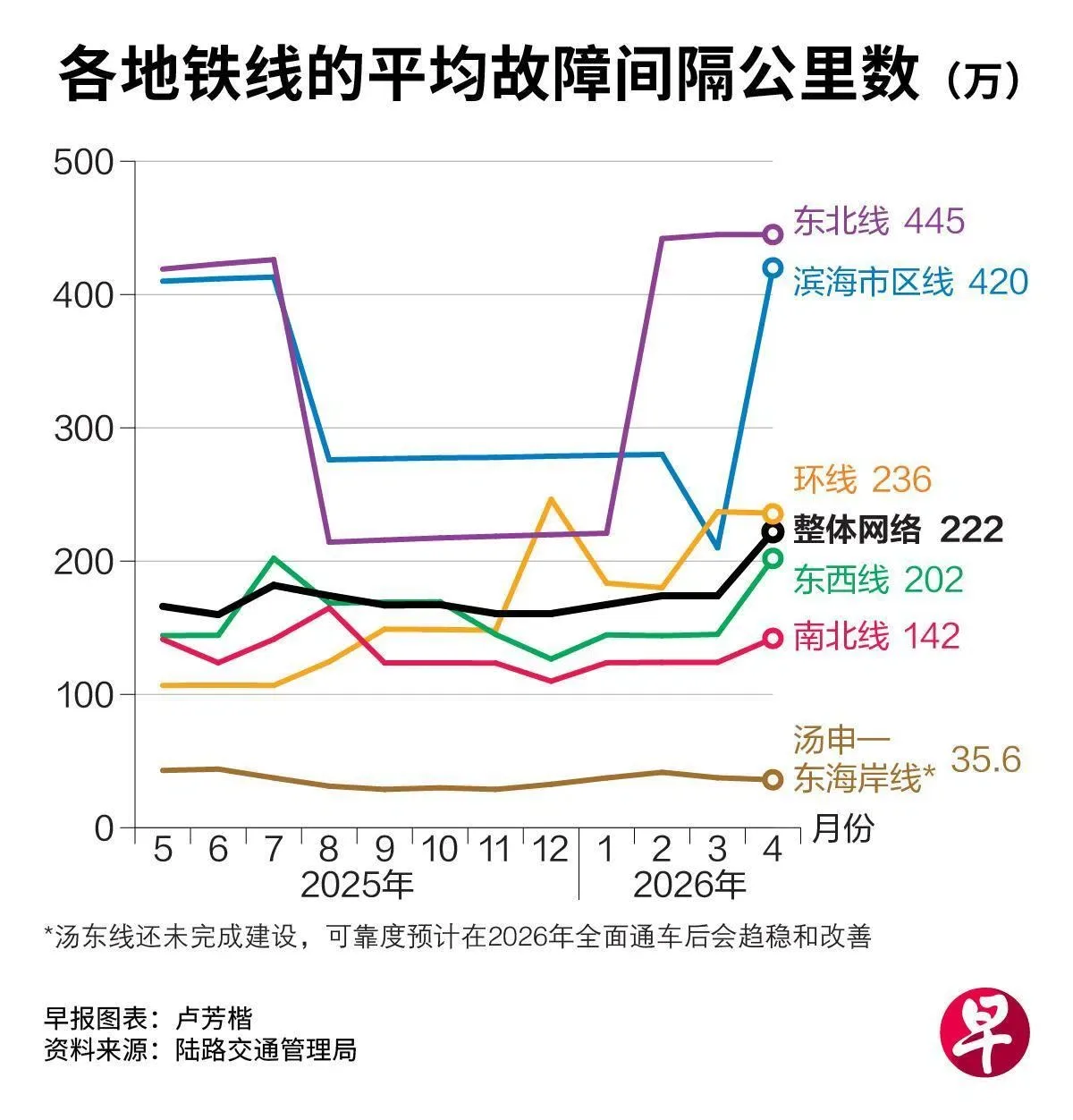
Singapore's Mass Rapid Transit system saw improved reliability in April 2026, with the overall network's mean kilometres between failures (MKBF) rising to about 2.22 million train-km, up from 1.74 million train-km in March 2026, marking the first time since November 2024 it has exceeded 2 million train-km [1, 2].
The Downtown Line showed the most significant improvement, doubling its MKBF to 4.2 million train-km in April from 2.1 million train-km in March 2026 [1, 2]. The North-East Line maintained steady performance with a MKBF of 4.45 million train-km [1, 2].
Other lines also saw gains. The East-West Line's MKBF increased to around 2.02 million train-km, up from 1.45 million train-km in March [1, 2]. The North-South Line improved to 1.42 million train-km from 1.24 million train-km [1, 2]. Meanwhile, the Circle Line had a slight decline in reliability, with MKBF dropping marginally to approximately 2.36 million train-km from 2.37 million train-km [1, 2].
The Thomson–East Coast Line's MKBF declined from 374,000 train-km in March to 356,000 train-km in April, attributed to ongoing system integration work in its fifth phase [1].
Light Rail Transit (LRT) systems showed better reliability numbers with overall MKBF rising to 465,000 train-km in April 2026 from 374,000 train-km in March [1]. The Sengkang–Punggol LRT MKBF increased from 749,000 to 881,000 train-km, while the Bukit Panjang LRT improved from 186,000 to 239,000 train-km between March and April [1].
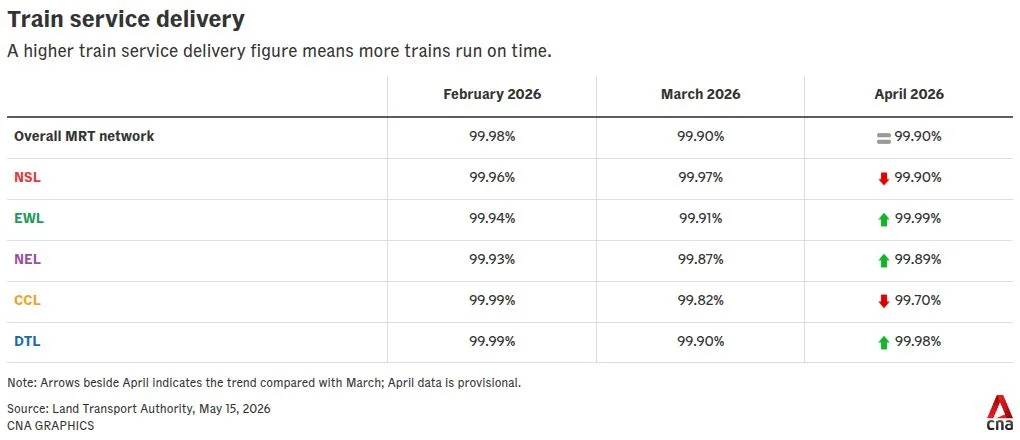
Train punctuality also improved slightly, with the overall rate rising to 99.48% in April from 99.43% in March 2026 [1]. Most lines, including the Downtown, East-West, North-South, and North-East Lines, saw punctuality rate rises. The Circle Line was the only line to see a decline in punctuality [1].
There were no MRT delays exceeding 30 minutes during April 2026. The last such delay occurred in November 2025 [2].