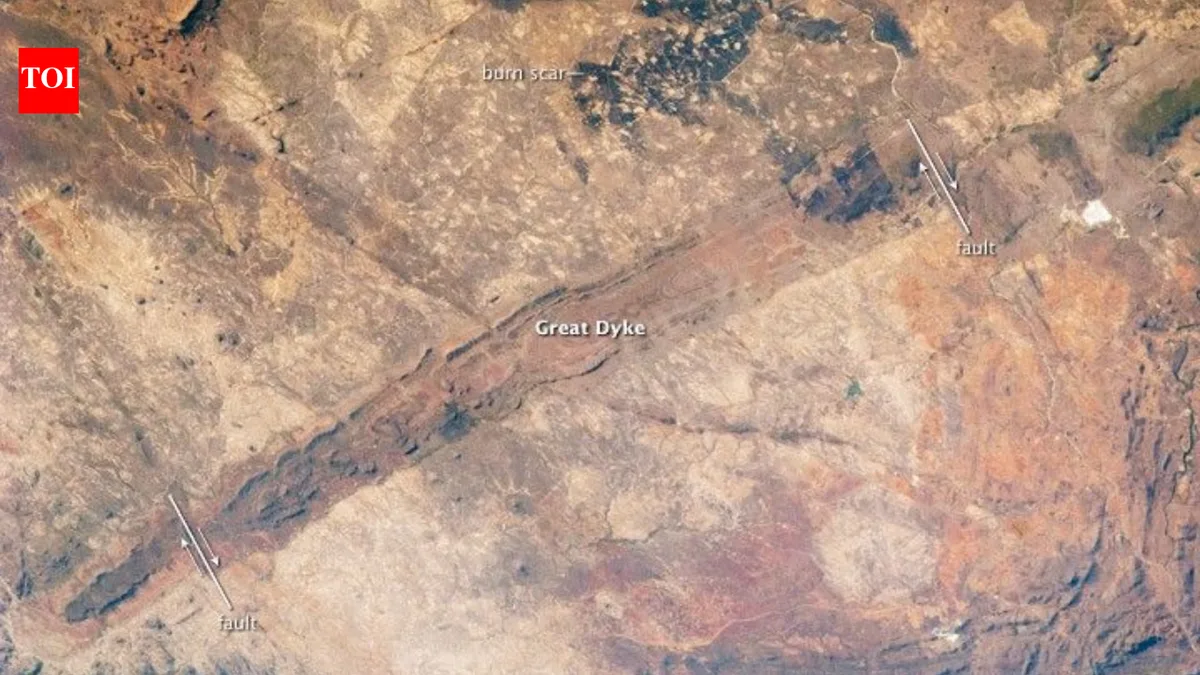
Scientists studying satellite imagery and geophysical mapping, supported by NASA funding, have discovered a hidden internal structure within Zimbabwe’s Great Dyke, a prominent geological formation in southern Africa [1]. The Great Dyke spans over 500 kilometres in a nearly straight line and dates back approximately 2.5 billion years to the Archaean Eon [1].
The newly identified feature lies beneath the surface and was not detected through traditional surface observations. Researchers estimate this hidden internal formation shares the Great Dyke’s ancient age of around 2.5 billion years [1]. The team suggests it could be an old magmatic pipe or a region where magma was stored, cooled, and chemically differentiated during early Earth processes, although this interpretation remains tentative [1].
In their report, the scientists emphasize the value of combining remote sensing and gravity data for uncovering subsurface heterogeneities linked to early magmatic and tectonic activity. They stated, “Remote sensing and gravity data enable us to reveal subsurface heterogeneities related to early magmatic and tectonic events,” highlighting the ability of these methods to provide new insights into ancient geological structures [1].
The discovery sheds light on complex early Earth magmatic systems preserved in one of the planet’s oldest and longest geological features. Research teams plan to extend their analysis using additional remote sensing data to better characterize the internal structure and its role in the Dyke’s formation dynamics.