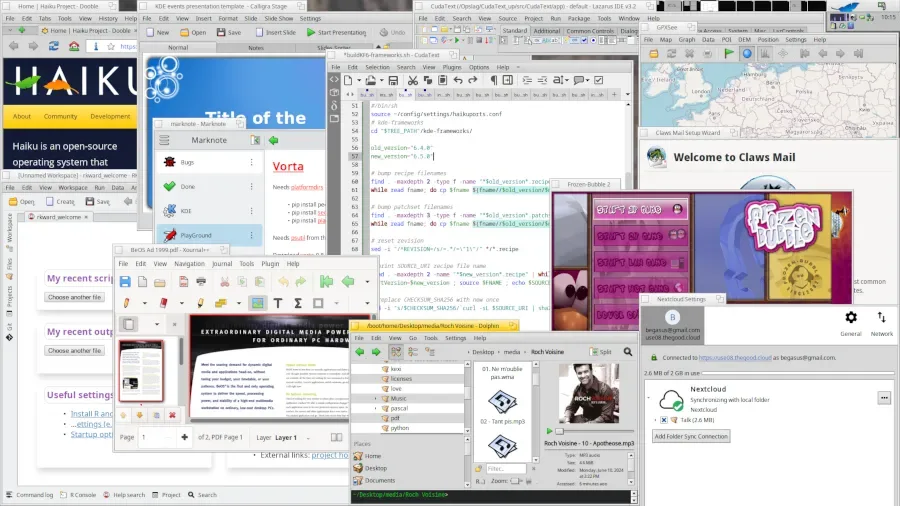
Haiku said in its April 2026 status report that it added basic SMP support for ARM64, enough to run with multiple cores and threads in a QEMU virtual machine. [1, 2]
The open-source operating system project also said it made further hardware support changes in April, including MMC/SHDCI power-off handling and an imported zyd/zydwifi1211 driver from FreeBSD. [1] It said the media mixer was refactored to delay startup until an application connects to the output, a change meant to improve startup time and reduce CPU and power use. [1]
Haiku also announced its 2026 Google Summer of Code projects after the end-of-month selection round. [3] One project is titled “Modernizing Haiku’s Bluetooth Stack: HCI Completion and HID Profile Implementation,” and the broader Bluetooth work includes additions such as HFP profile support and support for HID devices. [3, 2] Leo Rouleau said, “I chose to apply for Haiku because of my interest in lower-level programming and operating systems.” [3] Mohammed R. Attia said, “I’ve been accepted into Google Summer of Code (GSoC) 2026 with Haiku, with my proposal titled ‘Modernizing Haiku’s Bluetooth Stack: HCI Completion and HID Profile Implementation.’” [3]
A second GSoC project will expand the Devices application so users can view detailed technical specifications and carry out administrative tasks from the GUI. [3, 2] Haiku said it is also continuing work toward its sixth beta release once additional bugs are fixed. [1, 2]
The project said its ltrace command has improved but is not yet ready for general use because tracing calls can still cause problems and crashes. [1] The April report covered work across hrev59570 through hrev59671. [3]