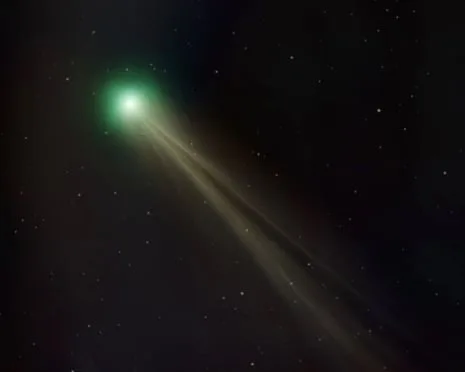
Comet C/2025 R3 PanSTARRS, originating from the Oort Cloud, is visible in southern hemisphere skies including New Zealand, Australia, South Africa, and the Pacific as of early May 2026 [1]. The comet was discovered in 2025 and takes approximately 170,000 years to orbit the sun, classifying it as a long-period comet [1].
Although it is not bright enough to be seen with the naked eye, observers can view it using binoculars, telescopes, or cameras [1]. Astronomer Josh Aoraki of Te Whatu Stardome said, "It's not naked-eye brightness … [but] this one is a decently easy one to photograph, which is always nice," adding that, "you get the coma and the tail looking like a little fuzzy meteor in the sky" [1]. The comet’s blue-green coma and smudgy tail give it a distinctive appearance.
The comet will gradually decrease in brightness over the next two weeks from May 4, 2026, so observers are encouraged to look for it soon after sunset facing the western horizon [1]. Due to mass loss as it passes near the sun, the comet’s future trajectory remains uncertain. Aoraki explained, "It's really hard to predict the trajectory of them, because as they do go around the sun, they're losing mass, and that can change the path. So it could be back in that amount of time, but it also could be ejected from the solar system entirely" [1].
Comet C/2025 R3 PanSTARRS is expected to fade below visibility in the coming weeks. It has been visible since May 4 and will remain in southern hemisphere skies through about May 18, 2026 [1]. Observers in the southern hemisphere have a limited window to catch a view of the rare visitor before it disappears for at least 170,000 years.