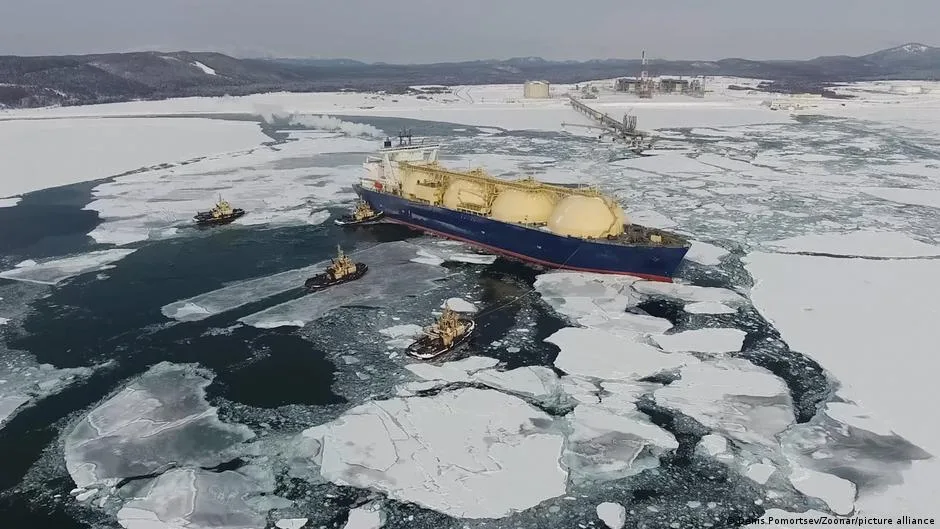
Russia is promoting the Northern Sea Route as an Arctic passage along its northern coast for cargo between Asia and Europe, even as the lane stays frozen much of the year and needs icebreaker help for much of the rest. [1]
The route can cut travel distance by up to 40% compared with the Suez Canal, but it is only fully open for a few months a year, from mid-summer to mid-autumn. [1]
Moscow had planned to move 80 million tons of cargo through the NSR by 2024, but Rosatom said about 38 million tons passed that year. That was less than 1% of global maritime trade, far below the up to 15% that usually goes through the Suez Canal. [1]
More than 80% of cargo on the NSR in 2024 was Russian crude oil and liquefied natural gas, showing the route still depends heavily on domestic energy shipments. [1]
President Vladimir Putin said in April 2026 that the route's importance as "the most safe, reliable and efficient path is becoming ever more obvious," but the channel's growth plans were stymied after Russia's 2022 invasion of Ukraine and the Western sanctions that followed. [1]
Russia is budgeting 1.8 trillion rubles, about €20.5 billion or $24 billion, for NSR development through 2035. Ksenia Vakhrusheva said, "Economics of the use of this route is not matching the image that Russia wants to create around it." [1]