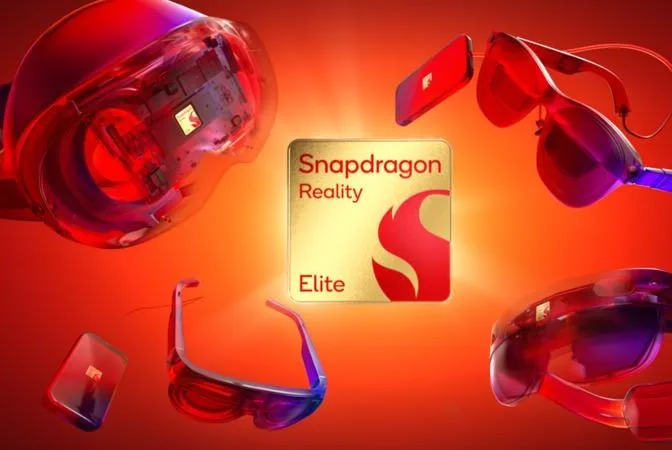
Qualcomm announced the Snapdragon Reality Elite chip at Augmented World Expo 2026 on June 16, targeting next-generation augmented reality (AR), extended reality (XR), and virtual reality (VR) devices [1, 2, 3, 4, 5]. The chip offers up to 60% higher GPU performance, up to 30% faster CPU speeds, and a 160% boost in neural processing unit (NPU) performance compared to previous XR chips [1, 6, 2, 3, 4, 5]. It supports 4.4K resolution per eye at 90 frames per second with lower latency, enabling sharper visuals and smoother motion [1, 6, 2, 3, 4, 5]. Battery life improves by up to 20%, and under heavy workloads the chip runs up to 12 degrees Celsius cooler than its predecessor [1, 6, 2, 3, 4, 5].
The Snapdragon Reality Elite delivers 48 TOPS (trillions of operations per second) in AI performance, powering advanced on-device AI features. These include support for large language models (LLMs), large vision models (LVMs), photorealistic avatars, and real-time dynamic content generation [6, 3, 4, 5]. Qualcomm director Matthew DeHamer described the chip as ushering in a "new phase" emphasizing "see-through" devices and generative AI capabilities [2].
Qualcomm also launched the Snapdragon START platform, an AI-readiness toolkit and modular platform to accelerate smart glasses development. The global eyewear group Inspecs is the first to adopt Snapdragon START for manufacturing smart glasses [2, 4, 7]. Qualcomm Senior VP Ziad Asghar said AI is becoming more personal and designed to interact closely with users, contexts, and activities [7].
The first product announced using the Snapdragon Reality Elite is Xreal's Project Aura Android XR glasses, set to launch in fall 2026 [1, 2, 3, 4, 5]. Qualcomm CEO Cristiano Amon predicted AI agents will replace traditional apps as the core of digital experiences and said smart glasses have the potential to become a major consumer electronics category. He stated, "AI代理人將成為新的應用程式,取代傳統應用程式在數位生活中的中心地位" and noted that smart glasses could be the next mainstream consumer product after smartphones [3, 4].
Worldwide, more than 60 million XR devices are currently in use, signaling growing demand for immersive technologies [5]. Qualcomm's Snapdragon Reality Elite aims to meet this demand with improved graphics, AI power, and battery efficiency while reducing heat generation.
Xreal's Project Aura glasses with the Snapdragon Reality Elite chip are expected to launch commercially in the fall of 2026, marking the first availability of devices based on the new platform [1, 2, 3, 4, 5].