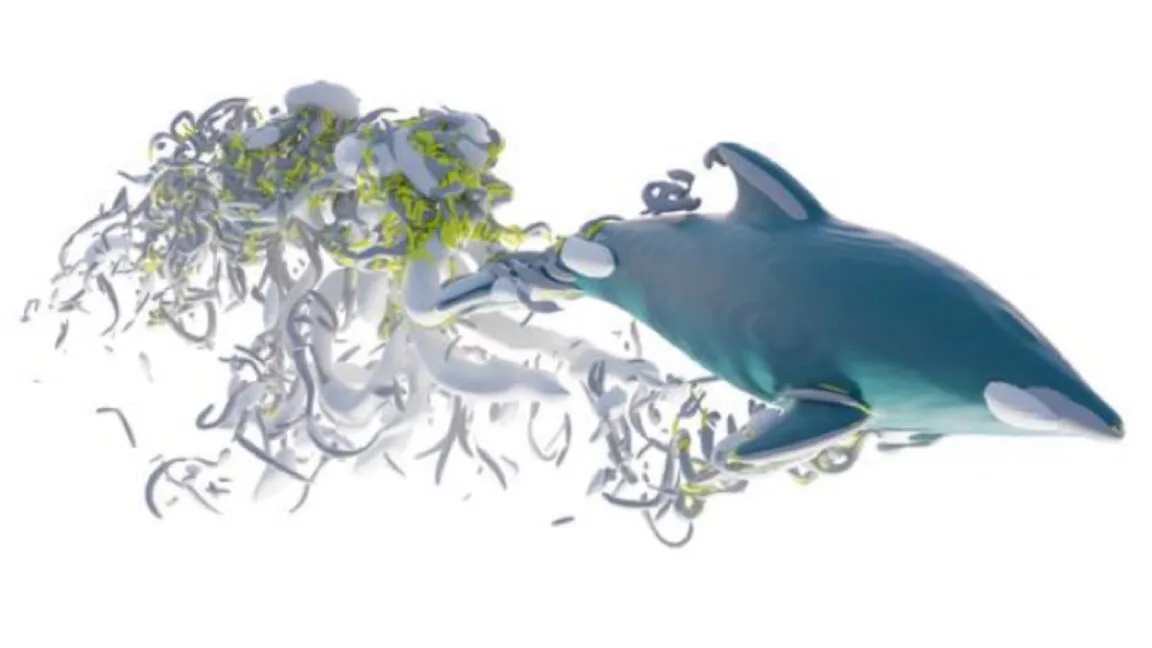
Japanese scientists from the University of Osaka used supercomputer simulations to study how dolphins achieve their speed and agility in water [1]. The team found that dolphin propulsion is driven mainly by large vortex rings created by oscillations of the tail, while smaller vortices are mostly byproducts of turbulence [1]. "Our results show that the hierarchy of vortices in turbulence is crucial for understanding dolphin swimming," lead researcher Susumu Goto said [1]. He explained, "The largest vortices are responsible for most of the propulsion, while the smaller ones are mainly byproducts of turbulent flow" [1]. The research was published in the journal Physical Review Fluids earlier this year [1]. These findings have potential applications beyond biology, as the team noted the results could help inform the design of faster and more efficient underwater robots [1]. In April, Ars Technica included this dolphin swimming study as one of six science stories in its science roundup, highlighting its impact in the scientific community [1].
Japanese Researchers Use Supercomputer Simulations to Reveal How Dolphins Swim Fast
Scientists at University of Osaka used simulations to show dolphin speed comes from large vortex rings in tail motion.

Gallery




Sources
- Ars Technica — Research roundup: 6 cool science stories we almost missed