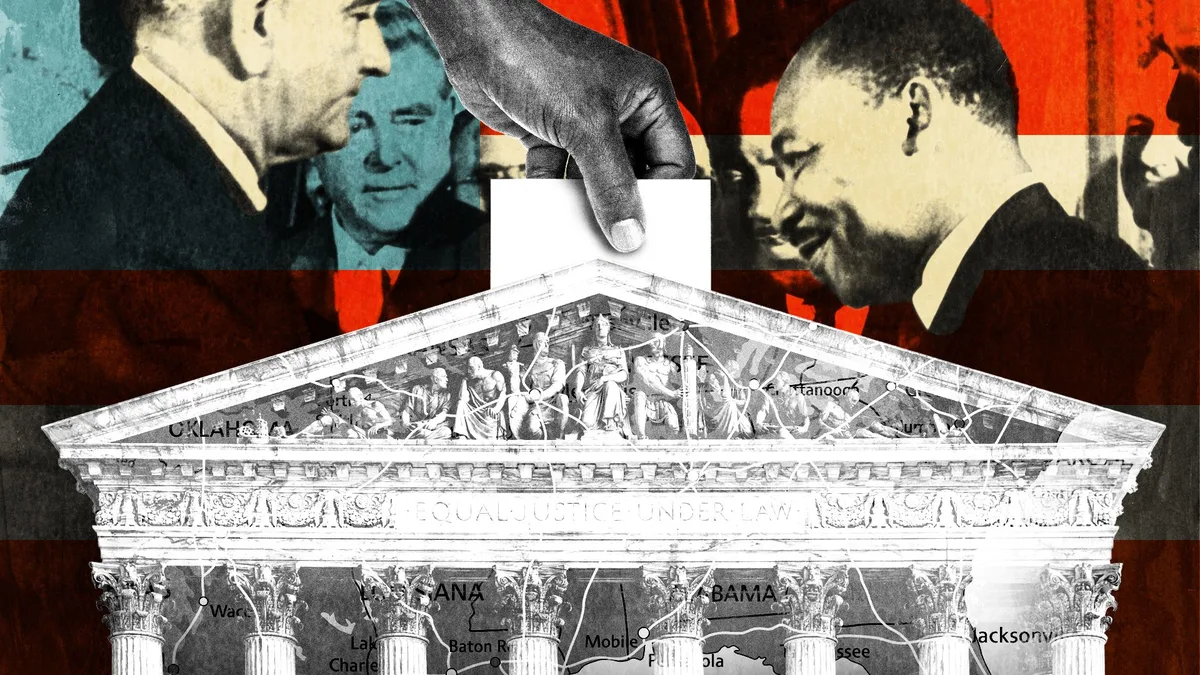
The U.S. Supreme Court issued its decision Wednesday in Louisiana v. Callais, narrowing Section 2 of the Voting Rights Act [1]. Section 2 had prohibited racially discriminatory gerrymandering and expanded voting protections for people of color, particularly Black Americans in the South [1].
The ruling reduces federal oversight as states redraw political maps, effectively giving states fewer guardrails against racial discrimination in elections [1]. Justice Samuel Alito wrote that the decision aims to avoid "forces[ing] States to engage in the very race-based discrimination that the Constitution forbids" [1].
Critics warned the ruling undermines voting rights advances. Sophia Lin Lakin, director of the ACLU Voting Rights Project, called it "a profound betrayal of the legacy of the civil rights movement" [1]. NAACP President Derrick Johnson described the ruling as "a devastating blow" and "a license for corrupt politicians who want to rig the system" [1]. Justice Elena Kagan dissented, saying the ruling "will set back the foundational right… of racial equality in electoral opportunity" [1].
The decision comes at a time when the U.S. is more multiracial and mobile than in 1965, when the Voting Rights Act was enacted. Whites made up about 85% of the population then, compared to closer to 59% today. The multiracial population grew 276% from 2010 to 2020 [1]. Latino and Asian American populations have driven much of the country’s growth, reshaping political maps in states like Texas, Georgia, and Arizona [1].
The ruling marks a significant change for federal protections against racial gerrymandering and will affect how states draw districts in future elections [1].