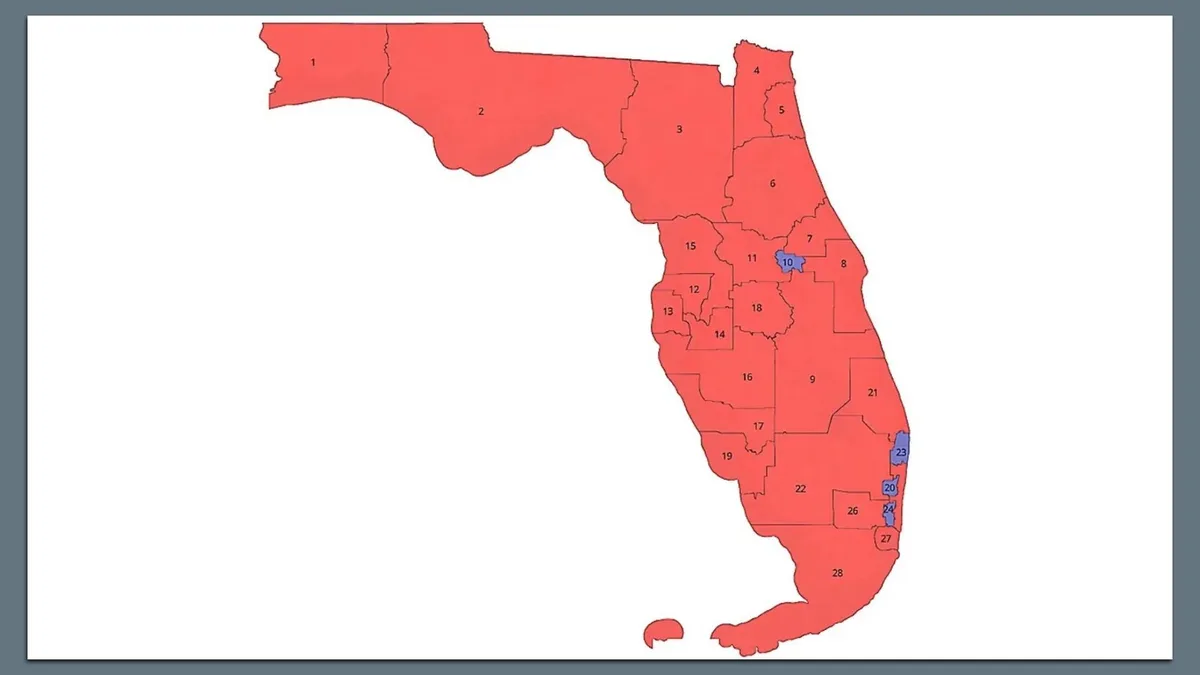
Florida Governor Ron DeSantis' office released a new congressional map claiming 24 Republican districts and 4 Democratic districts, up from 20 Republican seats previously [1]. The total number of congressional seats in Florida remains at 28 after redistricting; the proposal only redraws boundaries [1].
The map appears designed to increase Republican seats in Congress, raising concerns it violates the Fair Districts Amendments passed by 63% of Florida voters in 2010. These amendments ban partisan gerrymandering by requiring compact districts and protecting minority voters [1]. Florida’s constitution explicitly forbids intentionally drawing legislative maps to benefit either political party [1].
DeSantis' legal counsel challenged the Fair Districts Amendments, arguing they are unconstitutional since they resemble the federal Voting Rights Act and thus should be nullified [1]. Harvard law professor Nick Stephanopoulos expressed skepticism, saying, "I'm skeptical the Fair Districts Amendments would 'have any teeth,' given the state Supreme Court — all but one of whom were appointed by DeSantis — has already chipped away at it" [1].
Democratic and liberal groups have vowed to sue immediately once the new maps pass [1]. The Florida legislature is scheduled to hold a special session on Tuesday, April 28, 2026, to consider DeSantis' proposed congressional map [1].