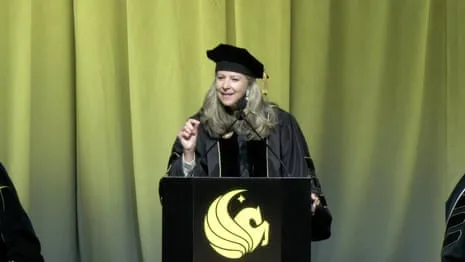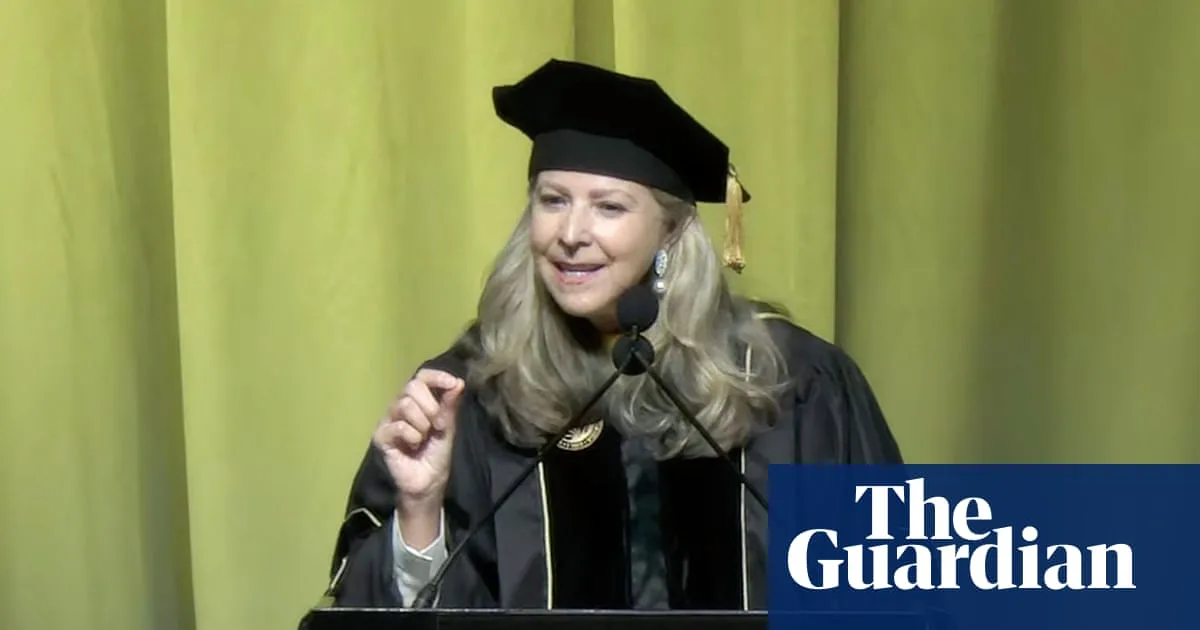
Gloria Caulfield, Vice President of Strategic Alliances at Tavistock Development Company, gave the commencement address on May 11, 2026, at the University of Central Florida’s College of Arts and Humanities and Nicholson School of Communication and Media graduation ceremony [1, 2]. During her speech, Caulfield described artificial intelligence as "the next Industrial Revolution," provoking loud boos from the crowd of graduating students [3, 1, 2, 4].
Reacting to the negative response, Caulfield remarked, "Woop, what happened? OK, I struck a chord. May I finish?" [3]. She then added, "Only a few years ago, AI was not a factor in our lives," which was met with cheers and applause from the audience [3, 1, 2].
The graduates’ boos reflected widespread concerns about AI's impact on jobs and career prospects, particularly beyond Silicon Valley. Fields such as graphic design, Hollywood, journalism, arts, and media are seen as vulnerable to automation and displacement [3, 2, 4]. Since early 2026, at least 12 major companies have cited AI as a factor in layoffs, fueling anxieties among the new workforce [2].
Caulfield acknowledged AI's potential, saying, "Being an optimist here, AI, alongside human intelligence, has the potential to help us solve some of humanity's greatest problems. Many of you in this graduating class will play a role in making this happen" [2]. Yet, the divide between business leaders’ optimism and graduates' fears was stark. On social media, users criticized the timing of Caulfield’s comments, one posting on X that "expecting students bankrupted by their education to celebrate the thing that's about to make their degree worthless is the final boss of tone deaf" [2]. Another user wrote, "Shocker. Graduates dont love AI as much as the boomers using it to replace their jobs" [2].
Caulfield’s address highlighted the tension between rapid AI adoption and uncertain job futures for recent graduates in affected industries. The University of Central Florida ceremony on May 11 brought these conflicting attitudes to the forefront as students prepared to enter a labor market undergoing technological disruption [1, 2].