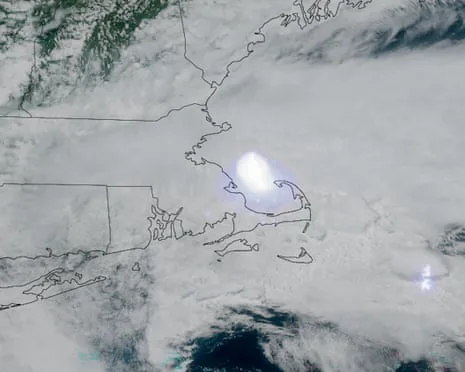
A meteor entered Earth's atmosphere and exploded over northeastern Massachusetts and southeastern New Hampshire on May 30, 2026, at 2:06 p.m. local time. The blast released energy equivalent to about 300 tons of TNT, producing loud double booms heard across several states, including Massachusetts, New Hampshire, Rhode Island, and other parts of New England [1, 2, 3, 4, 5, 6, 7].
Traveling at approximately 75,000 miles per hour (120,700 km/h), the meteor fragmented at an altitude of around 40 miles (64 kilometers) as it passed near the New Hampshire-Massachusetts border [1, 2, 3, 4, 5, 6, 7]. The object was roughly 3 feet (1 meter) wide when it entered the atmosphere [3, 4, 8]. The American Meteor Society's Robert Lunsford said, "It was definitely bigger than a normal fireball, about a yard wide," noting it could have landed in the ocean if any fragments survived the breakup [3].
The explosion caused houses to shake and buildings to rattle due to the sonic boom. Social media and residents reported the loud booms and shaking, though no earthquake was recorded by the US Geological Survey at the time, confirming the effects stemmed from the meteor's airburst [1, 3, 4, 5, 6, 7]. NASA deputy news chief Jennifer Dooren said, "The energy released at breakup is estimated to be equivalent to about 300 tons of TNT, which accounts for the loud booms."
Dooren also clarified the meteor was a natural object unconnected to any active meteor showers and not space debris or a satellite re-entry [1, 2, 4, 5, 6]. Radar data suggests some debris may have fallen into Cape Cod Bay, possibly producing meteorites, though confirmation is pending [8]. Authorities report no injuries or damage linked to the explosion [8, 7].
The event marks an uncommon but natural atmospheric fireball over New England. Detailed analysis of trajectory and fragment recovery efforts may clarify the impact footprint. The meteor’s entry and explosion on May 30 at 2:06 p.m. remain the key data points for ongoing studies [1, 2, 3, 4, 5, 6, 7].