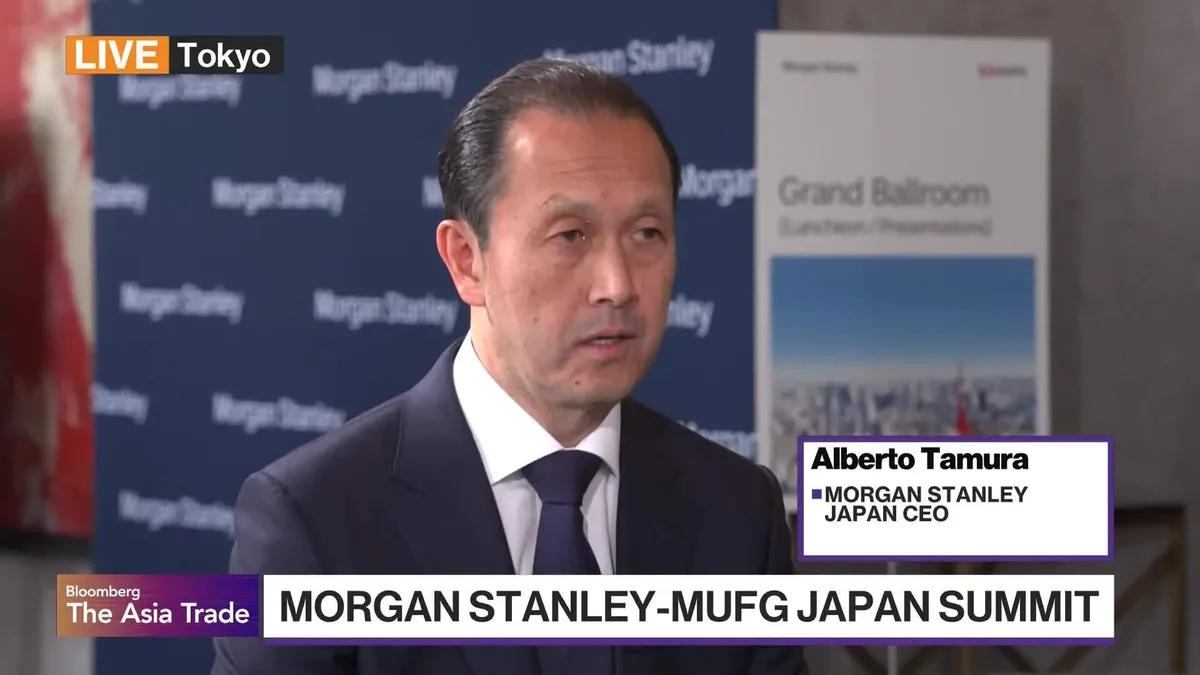
Alberto Tamura, CEO of Morgan Stanley Japan, said he hopes the yen strengthens to around 140 against the US dollar, with a Bank of Japan rate hike in June playing a key role in that movement [1, 2, 3]. Tamura warned that if the BoJ does not raise interest rates this month, the yen could weaken sharply to 170 against the dollar, or alternatively strengthen to 140, depending on market developments. "If the central bank fails to raise interest rates in June, that would have an impact on the bond and currency markets. The yen could either weaken to 170 versus the dollar or gain to 140, depending on how events unfold," he said [2].
Some investors believe the BoJ has been slow to react and want it to act promptly to support the yen’s value as it faces downward pressure [3]. Meanwhile, the Japanese government reportedly does not want the yen to depreciate substantially from current levels [3].
Scott Bessent, a US Treasury official, expressed confidence in BoJ Governor Kazuo Ueda’s ability to act if given sufficient policy independence from the government. Bessent said, "I believe BoJ Governor Kazuo Ueda, if given sufficient policy independence from the Japanese government, will take the necessary action." His comments were interpreted as a subtle message urging the Japanese government to respect the Bank’s monetary policy autonomy and allow normalization [3].
On the outlook for the yen, Bank of America Securities recently upgraded its view to neutral from bearish. BofA expects the USD/JPY rate around 152 by end-2026, down from their prior forecast of 157. Shusuke Yamada of BofA noted, "Despite divergence in yield spreads, yen’s structural fund flows are improving, loan-to-deposit ratios are shrinking, and higher real rates may start supporting the yen," highlighting improving fundamentals for the currency [4].
However, BofA also pointed out that yen strength depends on shifts in policy, forex markets, interest rates, and external factors such as oil prices [4].
Tamura spoke at the Morgan Stanley and MUFG Japan Summit on May 20, outlining his hopes for BoJ rate hikes and yen appreciation [1, 5, 2]. The BoJ’s policy decision expected this month remains a key event that could determine the yen’s trajectory in the near term.