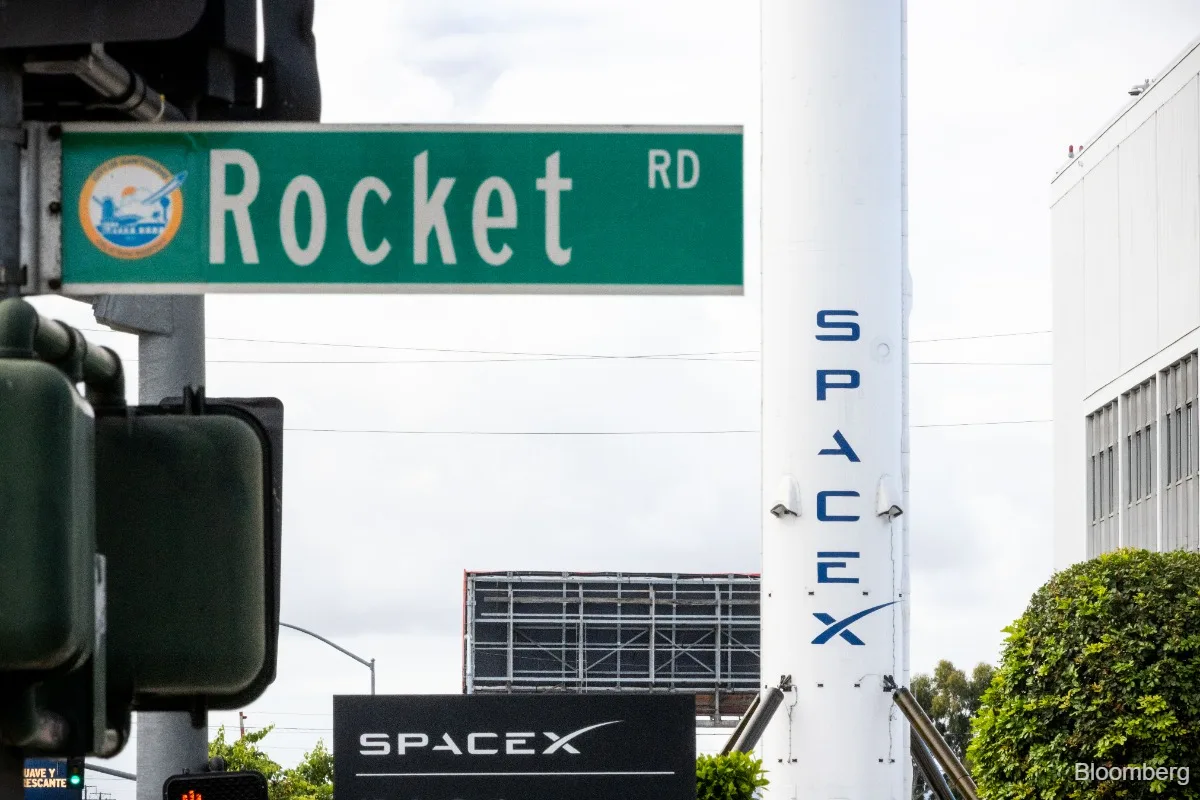
SpaceX completed its initial public offering on June 12, 2026, raising $75 billion in the largest IPO on record [1, 2, 3]. The company listed on Nasdaq at an IPO price of $135 per share and achieved a valuation exceeding $2 trillion, becoming the sixth-largest U.S. company by market capitalization [1, 4, 5].
Following the IPO, SpaceX stock surged roughly 49% over the first three days, lifting the market cap to approximately $2.5 trillion and ranking sixth worldwide [6, 4, 7]. However, shares declined about 5% on June 17 and fell another 5.8% on June 18, ending the initial rally amid volatility attributed to a limited float of 4.2% and activity among retail investors [6, 4, 8]. Michael Monaghan of Founder Funds called the dip "just noise so far" and expressed a willingness to add on further weakness [6]. Dave Mazza from Roundhill Financial described the declines as a "breather" after rapid gains, not a sign of fundamental problems [7].
On June 14, Elon Musk forecasted that SpaceX’s revenue could reach $1 trillion by 2030, saying he would be surprised if it did not pass that mark by 2031 [1, 5, 9]. This outlook contrasts with projections from major banks: Goldman Sachs estimates SpaceX revenue of about $470 billion by 2030, while Morgan Stanley forecasts $330 billion [1, 5, 9]. Andrew Beale of Arete Research counseled caution, noting "Space is hard and timelines can slip, so all estimates should be treated with a wide degree of caution" [8].
Financially, SpaceX’s revenue grew from $14.02 billion in 2024 to $18.67 billion in 2025, but the company recorded a net loss of $4.94 billion in 2025 compared with a $791 million profit in 2024 [1, 9]. Analysts note SpaceX’s leadership in reusable rocket launches and satellite internet via Starlink creates high barriers for competitors [10].
Among notable IPO investors, Australian billionaire Gina Rinehart’s Hancock Prospecting acquired about $1 billion worth of shares, marking a significant diversification from her mining interests. Rinehart remarked that SpaceX’s sector is "crucial and has long-term growth potential" [1].
Due to recent Nasdaq rule changes, SpaceX is expected to become eligible for inclusion in the Nasdaq 100 index around June 27 after 15 trading days [4, 8, 7]. It may also be added to FTSE Russell and MSCI indexes in the future [8].
SpaceX’s early trading volatility reflects a 20% retail allocation and a small tradable free float. Despite some analyst cautions, investor interest remains focused on the company's long-term growth prospects in space launch and broadband markets. SpaceX’s next key market event is its Nasdaq 100 inclusion eligibility later this month [4, 7].