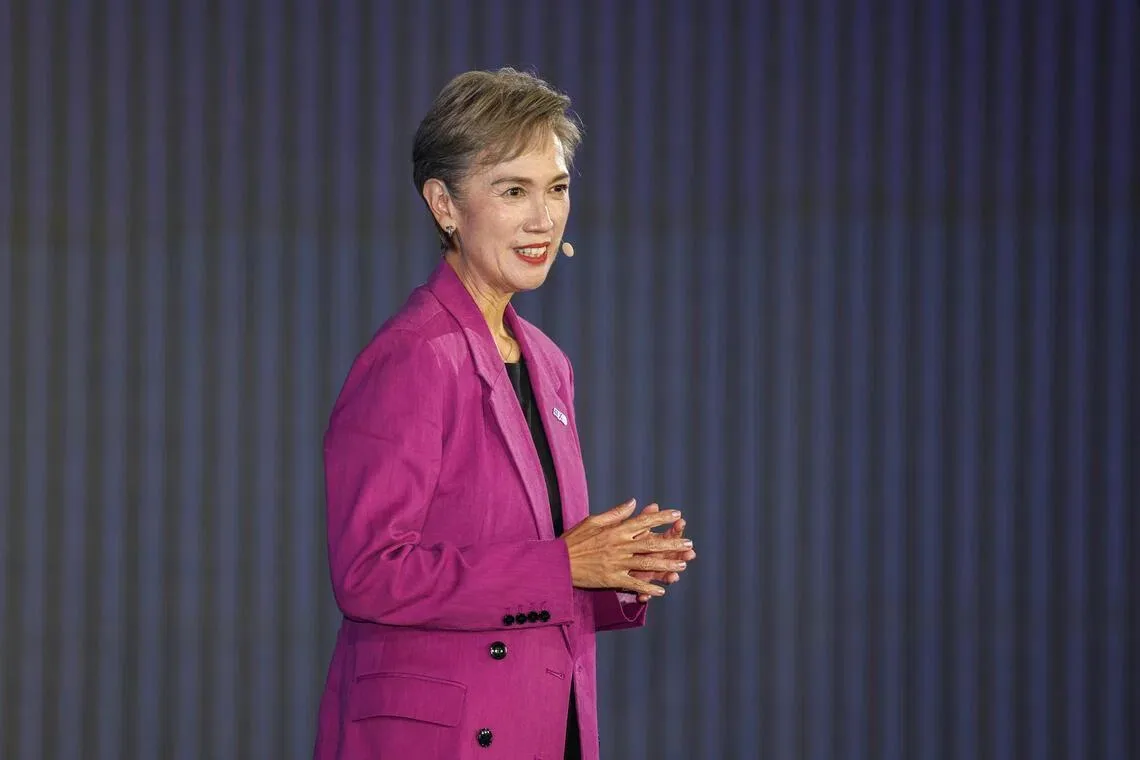
Singapore launched its National AI Missions on May 20, 2026, to transform key parts of the economy, announced by Minister Josephine Teo at the Asia Tech x Summit [1, 2]. The program targets four sectors: connectivity, advanced manufacturing, healthcare, and finance, which together accounted for 40% of Singapore’s GDP in 2025 [1, 2].
Minister Teo described the missions as "beachheads" designed for deep, game-changing AI adoption addressing global challenges. "The national AI missions will be driven by problem statements worth solving, not just for Singapore but for the world," she said [1]. She confirmed, "Work has already begun" on the initial AI mission focused on the aviation sector [2].
The aviation mission addresses passenger flow, baggage delivery, and the sequencing of aircraft landings and take-offs at Changi Airport, where Terminal 5 (T5) is under construction. When operational in the mid-2030s, T5 is expected to boost the airport’s capacity to over 140 million passengers yearly, about 55% above the 2025 capacity [1]. There is some discrepancy over current capacity figures: one source says 90 million passengers in 2025, another notes 70 million prior to expansion [1, 2].
Minister Teo emphasized that a next-generation air traffic management system "that prioritises safety and not just volume" is planned as part of the AI efforts in T5 [1]. She called this one of "the many exciting opportunities in T5 that AI can help with."
Beyond aviation, Singapore’s maritime sector is also set to benefit from these AI missions. Tuas Port, the new deep-water port being developed in phases, opened its first three berths in September 2022 and will complete its first phase with 21 berths by 2027. The initial phase will handle up to 20 million shipping containers [1]. The full four-phase development is expected to finish in the 2040s.
The National AI Missions aim to build capabilities in sectors contributing significantly to Singapore’s economy, helping accelerate AI adoption and operational efficiency. The next major milestone is the 2027 completion of Tuas Port’s first phase with expanded container handling capacity [1].