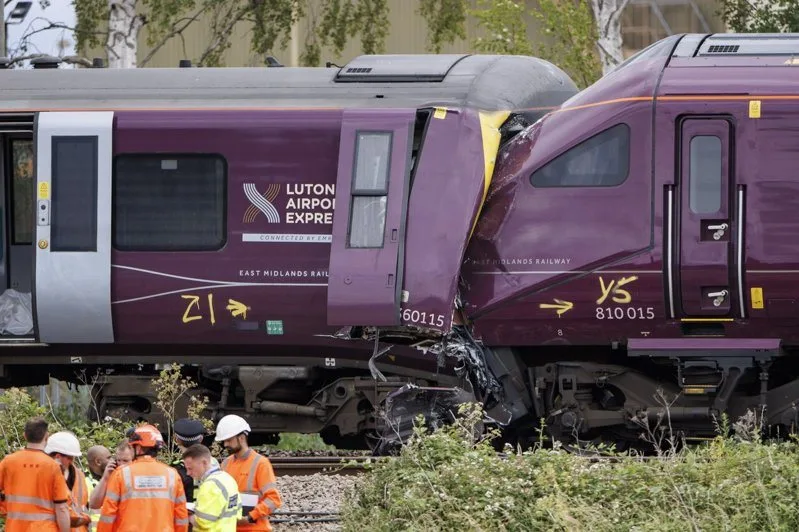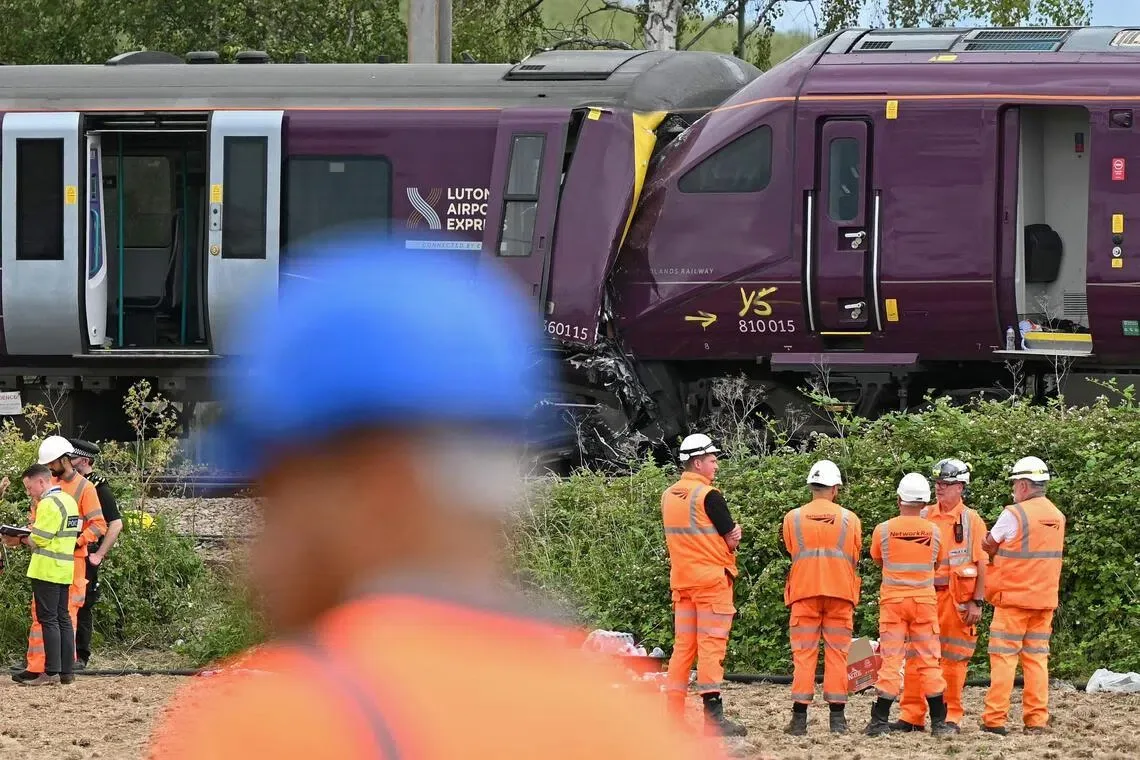
Two trains collided near London on June 19 when a moving train struck a stationary train on the same track, causing the death of the moving train's driver and injuring more than 100 passengers [1, 2, 3, 4].
Initial investigation released on June 24 found the moving train's driver passed a red signal before braking about nine seconds prior to the collision [1, 2, 3, 4]. At brake activation, the train was traveling roughly 76 mph (122 km/h) and slowed to about 49 mph (78-79 km/h) at impact [1, 2, 3, 4].
The red signal should have triggered audible and visual warnings in the driver's cabin, requiring driver acknowledgment or automatic emergency braking, investigators said [1, 2, 3, 4]. The stationary train had stopped due to a fault in its automatic warning system that applied its brakes [1, 2, 3, 4].
Data from the moving train's front black box is under analysis to clarify the status of its automatic warning system and the driver's reactions before the crash [1, 2, 3, 4]. Investigators are also examining the crashworthiness of both trains to assess survivability and impact resistance during the collision [1, 2, 3, 4].
As of June 24, 53 injured passengers remain hospitalized, with eight reported in critical condition [1, 2, 3, 4]. Transport Minister Heidi Alexander said on social media that "there is still much to establish and we will leave no stone untur[ned]" while the investigation continues [1].
Dave Calfe, Secretary of the Train Drivers and Firefighters Association, said it is "important to understand why and how the driver passed the red signal" [2, 3, 4].
Officials will continue analyzing evidence and system data as the inquiry progresses.