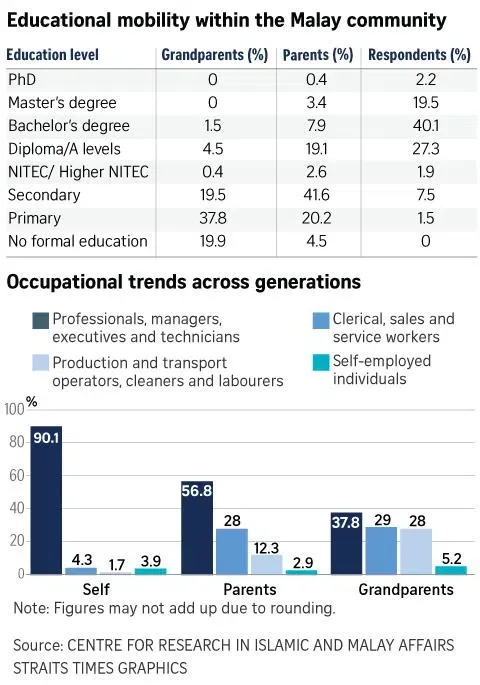
A study conducted by the Centre for Research on Islamic and Malay Affairs (RIMA) and AMP networks found that 79% of young Malays in Singapore have surpassed the educational levels of their parents, and 73.4% report being financially better off at the same age, signaling rising educational and economic mobility among the Malay community [1, 2, 3].
The study, carried out between 2024 and 2026 with a survey of 267 respondents and 33 in-depth interviews conducted from October 2024 to January 2025, shows about 90% of respondents hold professional, managerial, executive, or technical (PMET) roles compared with 37.8% in their grandparents' generation [1, 2, 3].
Despite these gains, the researchers identified a persistent "social capital deficit" as a barrier for some in translating formal education into career advancement and network access [1, 2, 3]. The report highlights, "Those with stronger social capital, such as access to mentors, professional family members or industry networks, were better able to navigate educational and career pathways, while others relied primarily on formal qualifications and personal effort" [1, 3].
The study's participants were primarily drawn from RIMA and AMP-affiliated networks, which may reflect perspectives of higher-educated Malays and not the broader community [1, 2, 3]. This context suggests social capital remains a dividing factor within the community despite rising academic achievements.
The findings were released on May 12, 2026, underscoring continued challenges amid progress for Malay social mobility in Singapore [1, 2, 3].