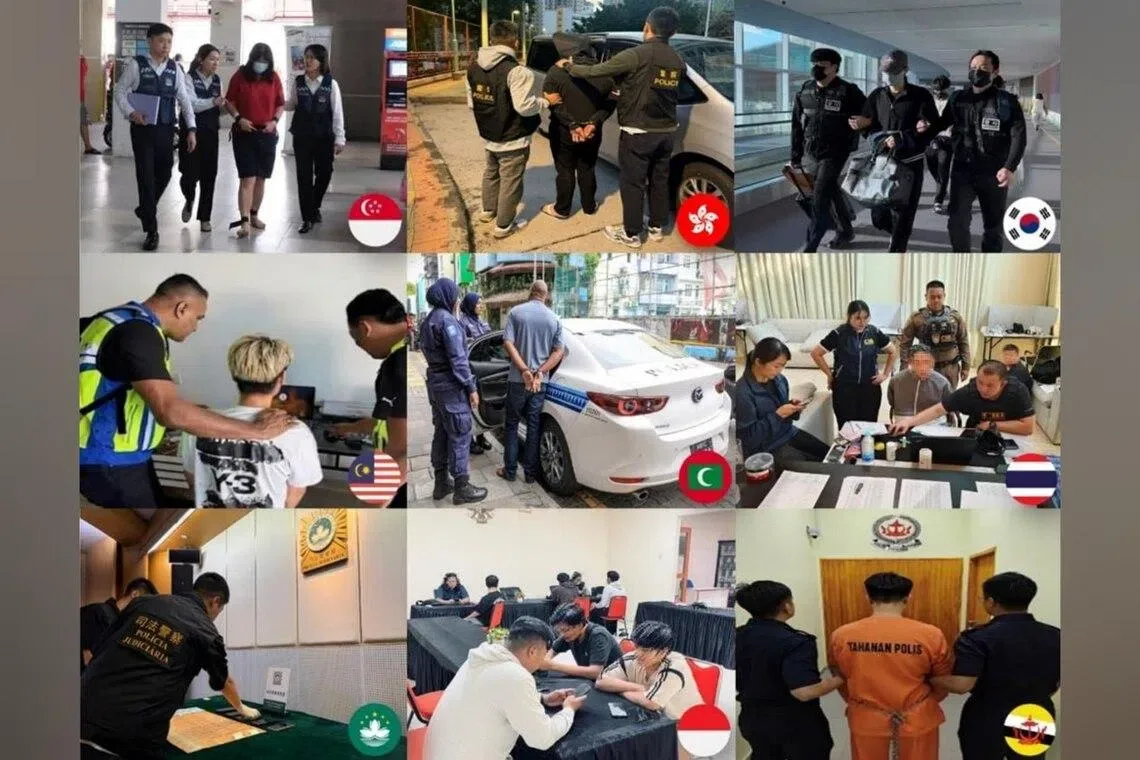
A two-month international law enforcement operation named Operation FRONTIER+ III ended May 7 after arresting 3,018 suspects across 10 territories, including more than 130 in Singapore, in connection with over 138,000 scam cases causing approximately US$752 million in losses [1, 2].
The operation ran from March 10 to May 7, 2026, and involved more than 3,200 officers from Singapore, Hong Kong, South Korea, Malaysia, the Maldives, Thailand, Macau, Indonesia, Brunei, and Canada [1, 2]. Authorities investigated 7,553 individuals worldwide linked to these scams [1, 2].
Globally, nearly 102,000 bank accounts were frozen and over US$161 million in illicit funds seized during the operation [1, 2]. In Singapore, the Police Force's Anti-Scam Centre investigated over 1,000 people associated with scams that caused more than S$69.3 million (around US$50 million) in losses [1, 2].
Singapore specifically froze 2,315 bank accounts and seized S$34.9 million (about US$23 million) in illicit proceeds. One notable scam involved a CEO receiving a WhatsApp call impersonating the company chairman, resulting in a US$36.3 million transfer to local bank accounts. Singaporean police seized US$9.7 million locally and coordinated with Hong Kong authorities who seized over US$11.1 million [1].
Another Singapore scam featured a commodity trading firm staff member sent a fraudulent email requesting a US$6.6 million fund transfer to an Oman-based account [1].
Collaboration between Singapore Police and Malaysia's Johor Commercial Crime Investigation Department led to the arrest of three Malaysians tied to a money laundering syndicate in Johor Bahru, where phones, bank tokens, and computer software were seized [2].
Following Operation FRONTIER+ III, a focused two-week police crackdown in Singapore ran from May 7 to 20, investigating 295 suspects aged 15 to 76 linked to more than 750 scam cases causing losses exceeding S$5 million. The scams included e-commerce, friend impersonation, job scams, government official imposters, investment fraud, and rental scams [3].
Suspects face charges such as cheating, money laundering, and providing payment services without a license, with penalties ranging from fines to prison terms up to 10 years and caning. Scam mules involved in laundering or sharing sensitive credentials may be subject to discretionary caning and restrictions on their banking and mobile services [3].
The Singapore Police Force said, "The Frontier+ network proved pivotal in cross-border fund-recovery efforts, as demonstrated by four successful cases during the period of the operation" [2].