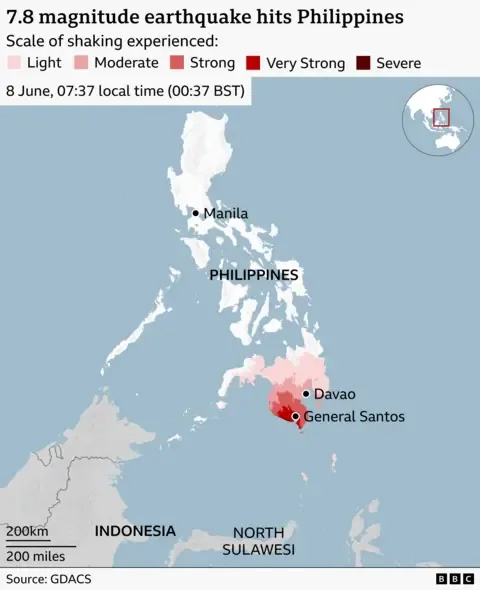
A magnitude 7.8 earthquake struck off the coast of Mindanao island in the southern Philippines on June 8 at 7:37 a.m. local time [1, 2, 3, 4, 5]. The quake occurred at a depth of 10 km, according to the German Research Centre for Geosciences (GFZ) and Philippine agencies, though the US Geological Survey (USGS) reported a deeper focus of 55.2 km [6, 7, 3, 4].
The earthquake was caused by movement along the Cotabato Trench, a known source of major quakes and tsunamis [2]. It triggered tsunami warnings in the Philippines, Indonesia, Malaysia, Japan, Palau, Taiwan, and Papua New Guinea, with waves potentially reaching up to 3 meters [1, 7, 3, 8, 4, 9, 10, 5]. Warnings were later lifted in Indonesia and Malaysia, but Malaysian coastal areas were urged to remain vigilant [10, 5].
At least 37 people have died and 487 have been injured, with officials warning the death toll could rise [2]. Initial reports varied, with other sources citing deaths ranging from 1 to 19 and 8 confirmed dead [1, 3, 4, 5]. Bernardo Alejandro, assistant secretary of the disaster response agency, said, "We hope the death toll does not increase further, but we are expecting it to move. Our priority today is search and rescue" [2].
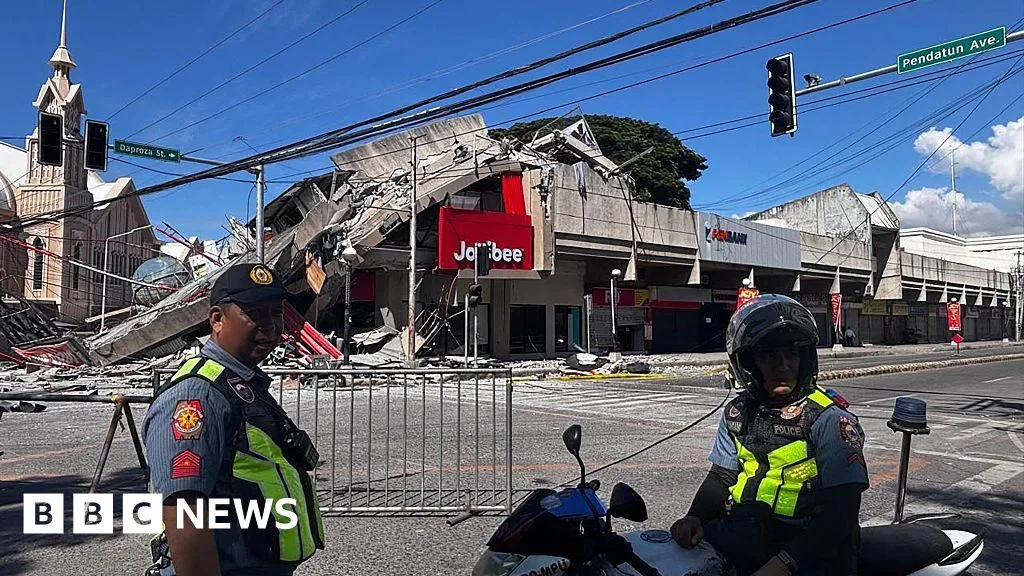
More than 130 aftershocks were recorded, ranging from magnitude 1.3 to 6.7 [1]. The quake caused significant damage, including the collapse of buildings such as a Jollibee fast food restaurant and a school in General Santos City [1, 3, 4, 5]. General Santos City and nearby provinces including South Cotabato, Sultan Kudarat, and Sarangani were heavily affected [1, 2, 3, 5]. Police chief Benjie Ancheta in Alabel town called it "the strongest earthquake we've experienced" [11].
President Ferdinand Marcos Jr ordered suspension of classes in the affected Mindanao areas on the first day of school and urged residents to evacuate. He said, "The national government is moving and we will not leave Mindanao behind," and urged people to "Move to higher ground now. Do not wait. Your life is more important than anything left behind" [1, 5]. Teresito Bacolcol, head of the Philippine Institute of Volcanology and Seismology, also recommended evacuation to higher ground or further inland [4].
No Malaysian nationals were reported affected as of June 8, though Malaysian authorities are monitoring the situation [10, 12].
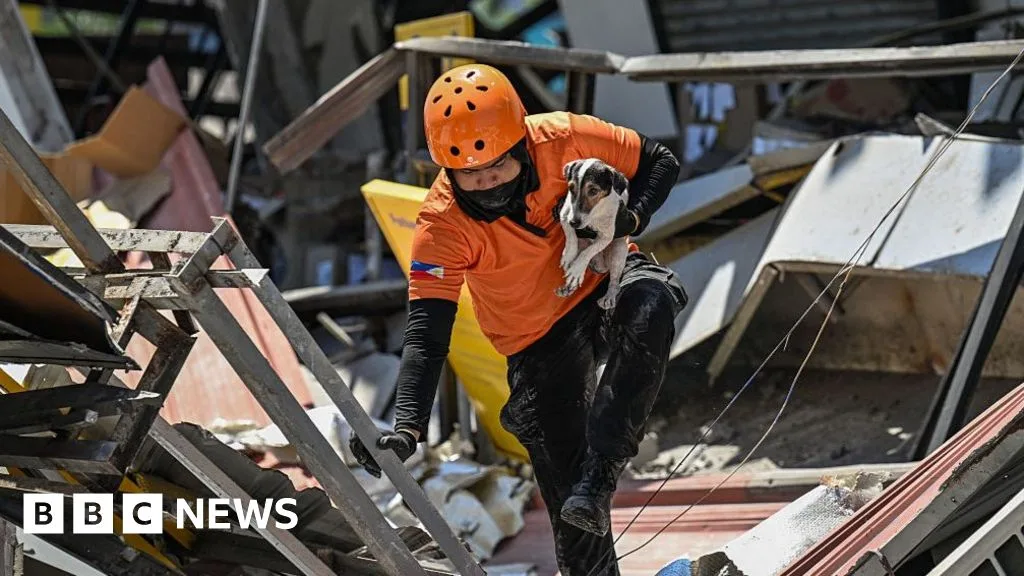
Officials continue search and rescue efforts, with multiple agencies coordinating damage assessment and relief. Close to 2,000 homes and 6,000 public school buildings were damaged by the quake, adding to concerns about infrastructure safety [2].