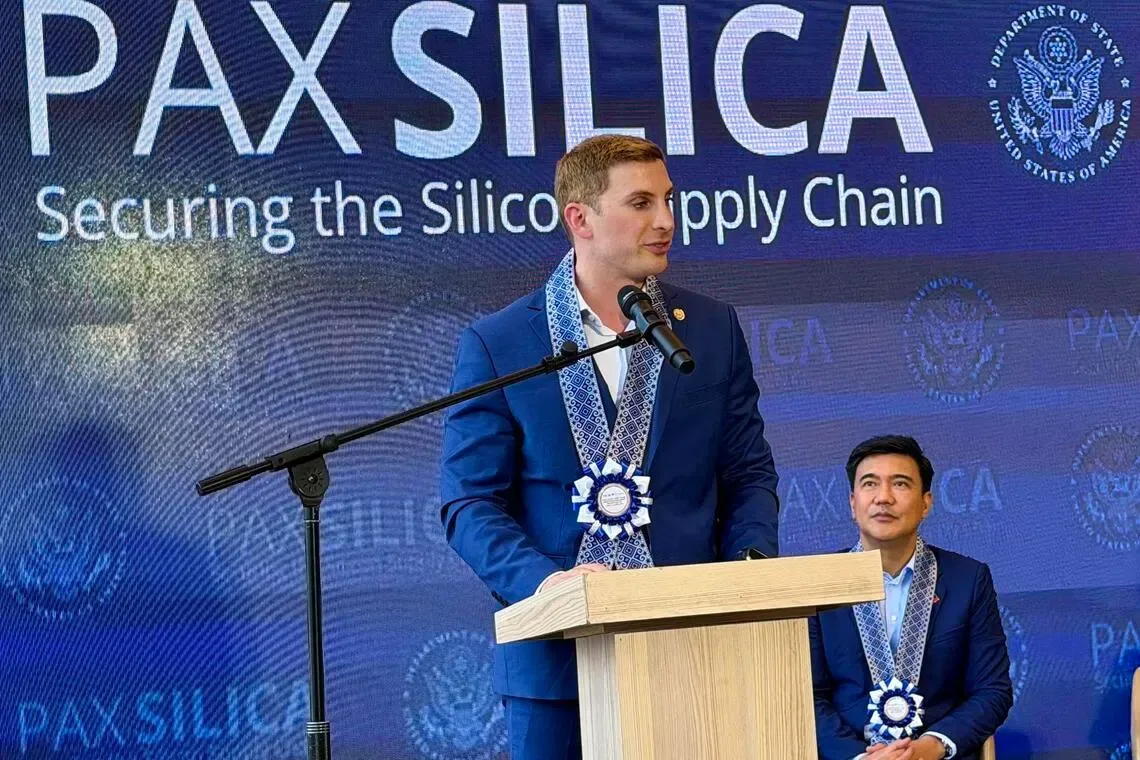
The United States and the Philippines are on track to reach an agreement soon on the long-term framework for an economic security zone, officials said on May 21 during the Asia Tech x Singapore (ATX) summit [1, 2]. Jacob Helberg, US undersecretary of state for economic affairs, said the deal will be reached "sooner rather than later" amid strong momentum behind the project.
The pact signed in April gives the two nations a two-year window to finalize arrangements for the economic security zone [1, 2]. The zone will establish sectoral industrial priorities to streamline economic activities and reinforce supply chains [1, 2].
The Philippines joined Pax Silica as the 13th member, expanding the technology supply chain alliance from its seven founding countries last September to 15 in May 2026, with 16 countries expected by the end of June [1, 2]. Pax Silica aims to strengthen technology and supply chain cooperation among democratic partners.
On May 18, Helberg visited a proposed 1,620-hectare site in New Clark City, north of Manila, accompanied by representatives from more than a dozen US companies, including Foxconn chairman Young Liu [1, 2]. Helberg noted strong US corporate interest in investing in the economic security zone [1, 2].
The US government is pushing for diplomatic immunity within the zone, but the Philippines has yet to agree to this condition [1, 2].
In Singapore, Helberg also met with digital ministers from ASEAN to explore regional collaboration opportunities [1, 2]. The expected final agreement aims to solidify the US-Philippines partnership under Pax Silica by establishing clear priorities and frameworks for industrial cooperation.
The two-year period to finalize the detailed arrangements under the April pact ends in April 2028, setting a clear deadline for the framework agreement to be completed [1, 2].