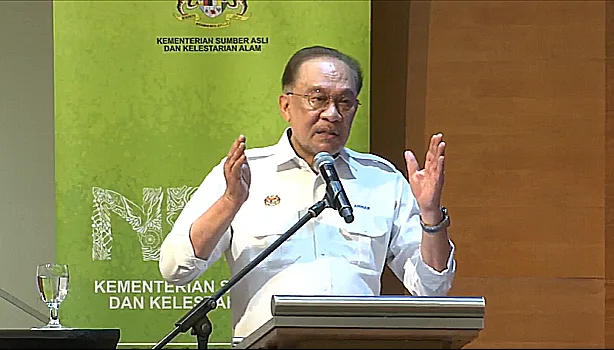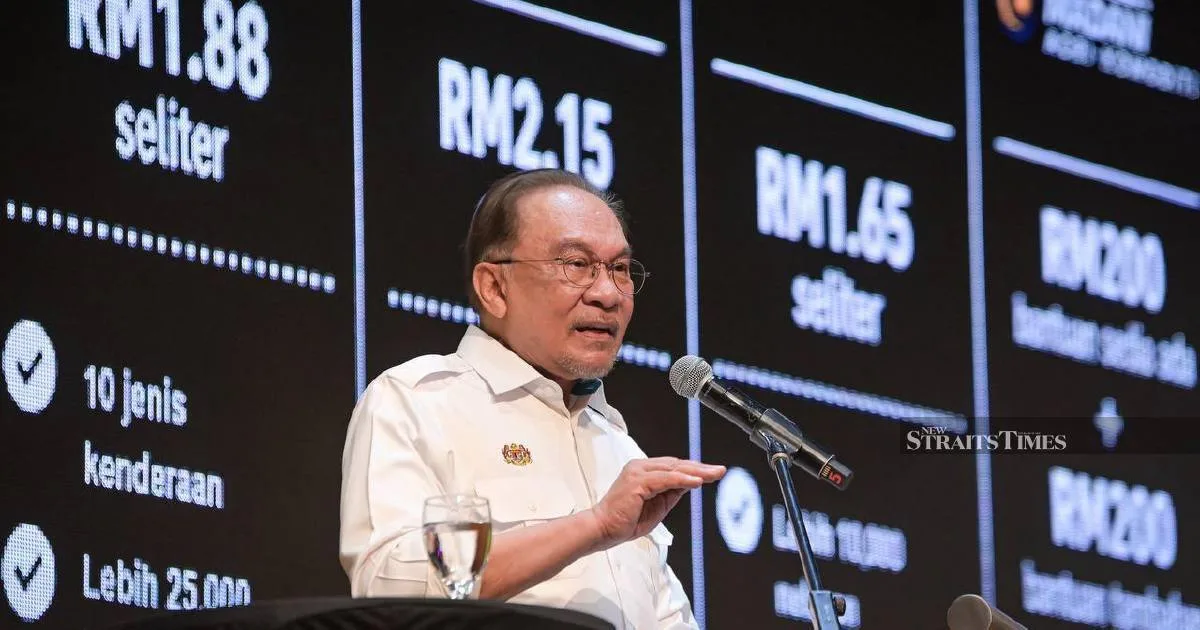
Prime Minister Datuk Seri Anwar Ibrahim announced today that Malaysia's monthly fuel subsidy burden has surged to about RM5 billion amid rising global oil prices linked to geopolitical tensions in West Asia. He made the announcement during a monthly assembly at the Natural Resources and Environmental Sustainability Ministry in Putrajaya on May 4, 2026 [1].
The current subsidy level shows a significant jump from the initial roughly RM700 million monthly allocation when the Budi MADANI subsidy scheme was introduced for RON95 petrol. The government implemented the subsidy to keep domestic fuel prices low and shield consumers from external price shocks [1].
Anwar attributed the increase in the subsidy bill to both higher crude oil prices and rising logistics costs including transport and insurance fees. "We are fortunate. Malaysia is among the countries with secure oil and gas supply. Our good relations with Iran, Russia and Turkmenistan give us supply assurances. So, in terms of supply, we have no problem, but the challenge is rising prices beyond our control," he said [1].
Despite the tight global market, Malaysia maintains a relatively secure oil and gas supply thanks to strategic cooperation with key producers. This has helped avoid supply disruptions even as prices climb amid Middle East conflicts [1].
Anwar estimated that if global prices surge further, the subsidy bill could exceed RM6 billion per month. "If prices surge further, it could exceed RM6 billion. But at current levels, it is RM5 billion a month. Imagine, over 10 months, that is RM50 billion from government funds," he said [1]. The total expenditure on fuel subsidies over 10 months could reach around RM50 billion.
He acknowledged rising inflationary pressures on households and urged civil servants to help communicate the fiscal realities. "Do we have a problem with living cost? Yes, I am not denying it. Must we manage this wisely? Yes. Can we afford to provide full assistance? I would say partially yes, because we cannot give total help because as you can see, even Budi95 has reached (RM5 billion) a month," Anwar said [1].
The government plans to keep domestic prices for RON95 petrol and diesel low to support consumers despite the volatile global oil market [1]. The subsidy burden highlights the fiscal challenge amid ongoing geopolitical tensions driving global oil price volatility.
Malaysia will continue monitoring the subsidy costs closely as global conditions evolve and update policy responses as needed.