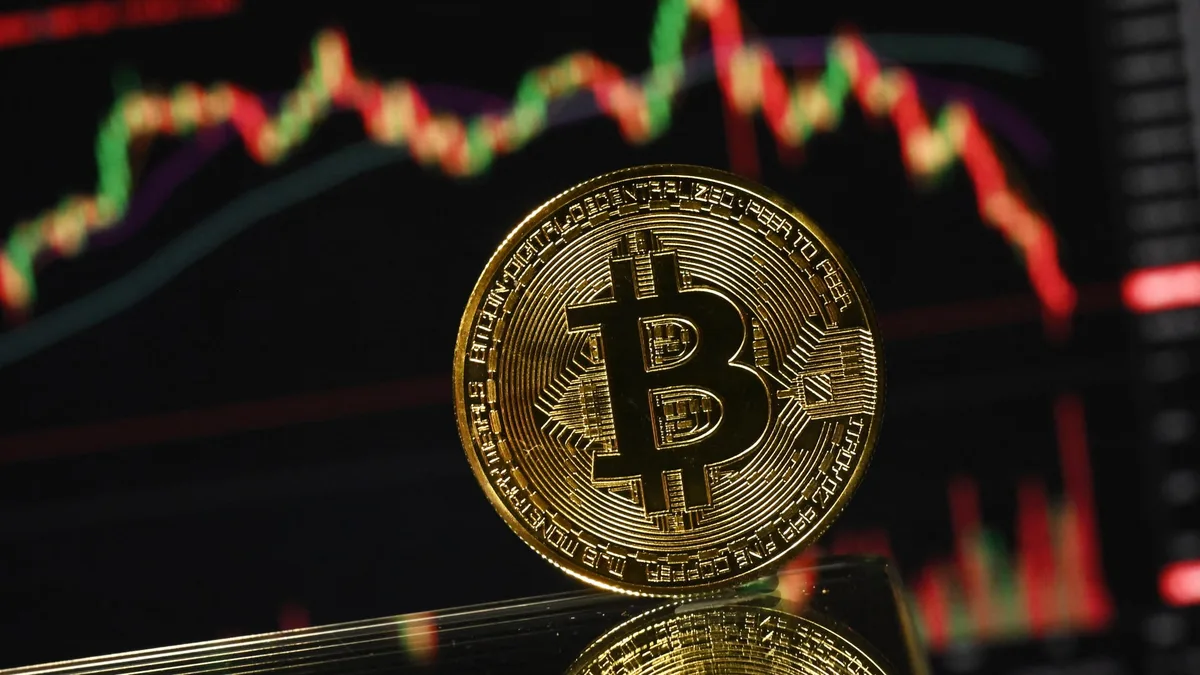
Bitcoin dropped to a nearly two-week low near $61,877 on June 23 before sliding below $60,000 on June 24, trading around $59,000 to $59,500, marking its lowest level since October 10, 2024 [1, 2, 3, 4]. This decline followed a sharp selloff in technology stocks, including firms focused on artificial intelligence, which spurred a risk-off mood among investors [1, 2, 4].
Other major cryptocurrencies also fell significantly. Ethereum dropped about 5.4-5.6%, Solana fell 6.4%, and XRP declined 3.3% across June 23-24 [1, 2, 4]. Shares of crypto-related companies such as Coinbase Global and Circle Internet Group also lost value amid the heightened selling pressure [2].
US-listed spot Bitcoin exchange-traded funds (ETFs) have experienced $2.4 billion in outflows so far in June, with $182 million exiting just this week [1, 2, 3]. Assets under management in Bitcoin ETFs have shrunk from roughly $113 billion at the end of 2025 to $77.5 billion mid-2026 [3]. This reflects a significant withdrawal of institutional and retail funds from these investment vehicles.
The global crypto market capitalization declined 4% on June 24, to about $2.06 trillion [4]. Bitcoin’s market capitalization fell 5% in 24 hours to $1.19 trillion on the same day as daily trading volume rose 17.4% to $35.5 billion, suggesting strong selling activity [4]. Bitcoin has lost 22.4% in June and 32% year-to-date as of June 24, 2026 [4].
Market participants attribute the selloff to multiple pressures including investor fears about heavy spending by AI firms, geopolitical tensions like the war in Iran, uncertainty over US Federal Reserve policies, and a rotation of capital into AI stocks and high-profile initial public offerings [1, 2, 3, 4]. Tian Zeng, CEO and CIO of Third Eye, noted that "Korean equities broadly have been leading the low breadth move in equities," linking regional market dynamics with crypto trends [2].
Despite the losses, some analysts point to increased institutional participation in Bitcoin trading, which has reduced volatility compared to earlier bear markets. Sam Callahan, director of bitcoin strategy and research at OranjeBTC, said, "Bitcoin's not as volatile as it was in previous bear markets because of the investor base: it's larger, more liquid, and more institutionalized now, so volatility is declining on both the upside and the downside" [3].
Bitcoin and crypto market watchers will monitor next week’s Federal Reserve meeting for policy signals that could influence risk sentiment and capital flows across assets.