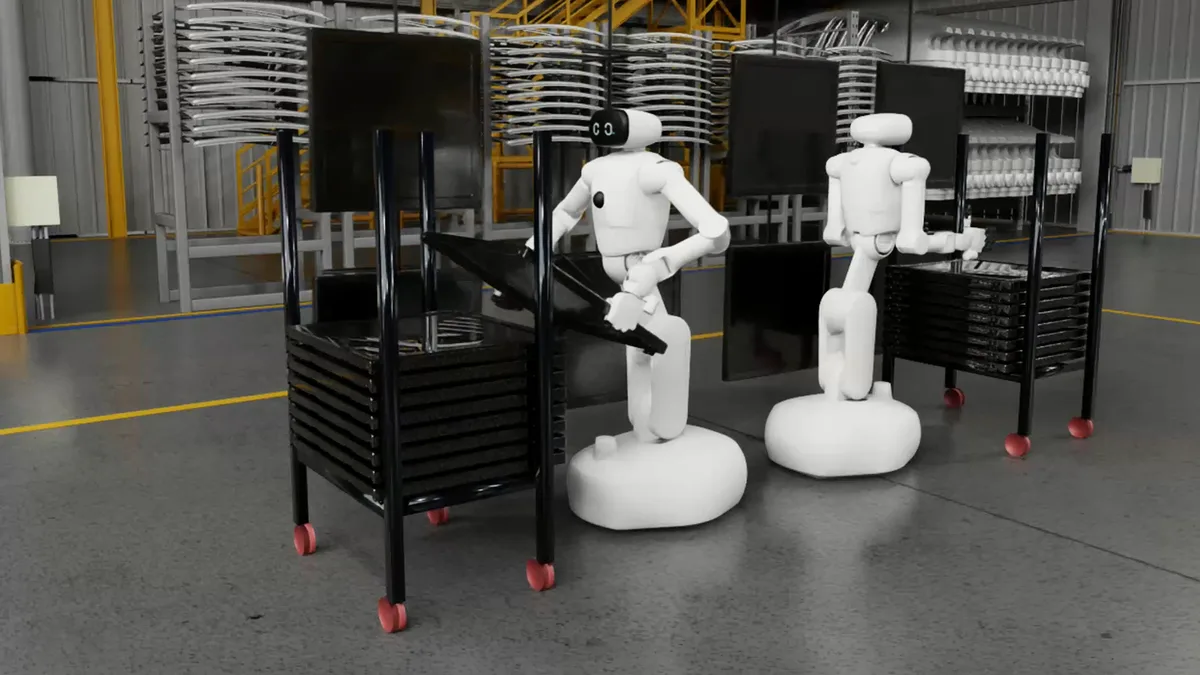
NVIDIA and LG Group announced on June 8 a joint effort to build an AI factory aimed at accelerating LG's AI-driven businesses in robotics, autonomous driving, data centers, and GPU cloud services [1, 2, 3]. The factory will integrate AI model development, physical AI data generation, robot simulation, training, edge deployment, and factory-scale digital twins into a unified workflow for physical AI systems [1, 2, 3].
Within LG, Electronics is developing home robots such as CLoiD using NVIDIA Isaac Sim and Isaac Lab frameworks. It plans to implement NVIDIA’s Isaac GR00T reasoning vision action language model to improve robot cognition [1, 2]. LG Electronics is also constructing a physical AI data factory designed to provide high-quality training data for both robotics and industrial AI applications [1, 2].
LG CNS will embed NVIDIA’s robotics technology into its PhysicalWorks industrial platform, while LG Uplus and CNS together plan to build scalable AI factory infrastructure based on NVIDIA’s DSX platform [2]. LG Electronics is aligning its vehicle-related efforts with NVIDIA’s DRIVE Hyperion architecture to advance ADAS and software-defined vehicle solutions [2]. The LG AI Research Institute is developing the EXAONE AI model using NVIDIA Blackwell GPUs and promoting it internally via ChatEXAONE [2].
Also on June 8, NVIDIA and SK Hynix announced a multi-year strategic collaboration to co-develop next-generation AI memory technology essential for global AI factories [4, 5, 3]. SK Hynix will develop specialized memory chips for NVIDIA's Vera Rubin AI supercomputer, Vera CPU, RTX Spark PC, and Jetson Thor robotics platforms [4].
To accelerate semiconductor design workflows, SK Hynix will use NVIDIA CUDA-X libraries and PhysicsNeMo frameworks for chip simulation and lithography. The company will also build digital twins of semiconductor fabs using NVIDIA Omniverse and cuOpt technologies [4, 5]. This partnership will allow SK Hynix to enter emerging AI fields such as personal AI and physical AI [4, 5]. Despite the lengthy R&D cycles typical for advanced memory development, the companies aim to secure stable supply of AI memory technologies [5].
NVIDIA CEO Jensen Huang said AI construction has just begun and likened AI's future role to that of the internet, describing AI as an unquestionable foundation for the world [3]. Huang also noted that recent global tech stock declines represent a buying opportunity [3].