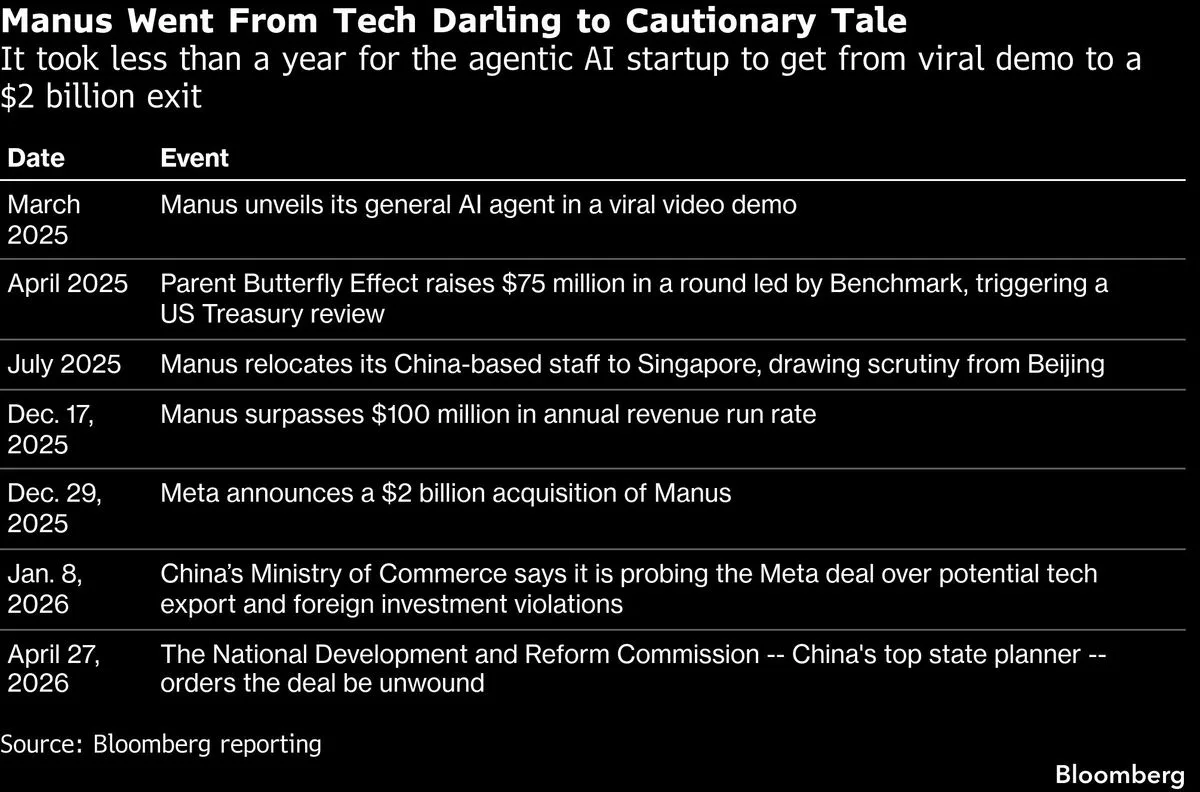
Meta Platforms completed an operational split from AI startup Manus and stopped all data sharing between the two companies by early June 2026 [1, 2, 3]. Since the start of June, Manus and its staff have been barred from accessing Meta's internal data systems, and Meta employees are no longer allowed to use Manus tools for internal projects [1, 2, 3]. Meta has instructed employees to migrate ongoing Manus projects onto Meta’s own platforms and to cease new work on Manus’s AI systems as part of "sunsetting" Manus [2, 3].
Meta acquired Manus for approximately $2 billion in December 2025, after Manus relocated its headquarters and key staff from China to Singapore earlier that year [1, 2, 3, 4]. The startup was considered a breakthrough in agentic AI with potential to challenge Silicon Valley dominance [2, 3, 4].
In April 2026, Chinese regulators ordered the unwinding of the acquisition, citing national security and technology export control concerns [2, 3, 4]. Authorities have tightened export controls and cross-border investment rules targeting strategic AI sectors [5, 6]. Han Shen Lin, China managing director at The Asia Group, said the unwinding "may be messy" and that Beijing’s actions signal limits to "Singapore washing," where companies relocate abroad to evade Chinese rules [5]. Lin added, "Beijing's new framework gives the state a kind of retrospective and prospective control over transactions. As long as Chinese funds have touched a deal, Beijing can claim jurisdiction" [7].
The unwinding is unprecedented under China’s foreign investment security review system, reflecting increased regulatory rigor [5, 7]. Matthias Hendrichs, a Singapore-based AI advisor, noted, "Chinese-origin AI now carries a kind of reversibility risk that no clever deal structure can price out." He added, "Once another company's engineers have been inside your stack, you can delete the repository, but you can't make them unsee what they've seen" [5].
Despite the unwind, Manus continues to release new features and integrates with platforms like Similarweb and Shopify [3, 6]. Meta and Manus employees are now physically separated, with Manus staff relocated into Meta offices in Singapore [2, 3].
Manus’s founders are exploring raising about $1 billion to buy back the company at a valuation matching Meta’s initial purchase price, which was paid out to early investors including Tencent Holdings Ltd, ZhenFund, and HSG [2, 3, 5, 6, 8].
The next key step will be the buyback process, with discussions underway as of May 2026 and no set deadline publicly disclosed [2, 5].