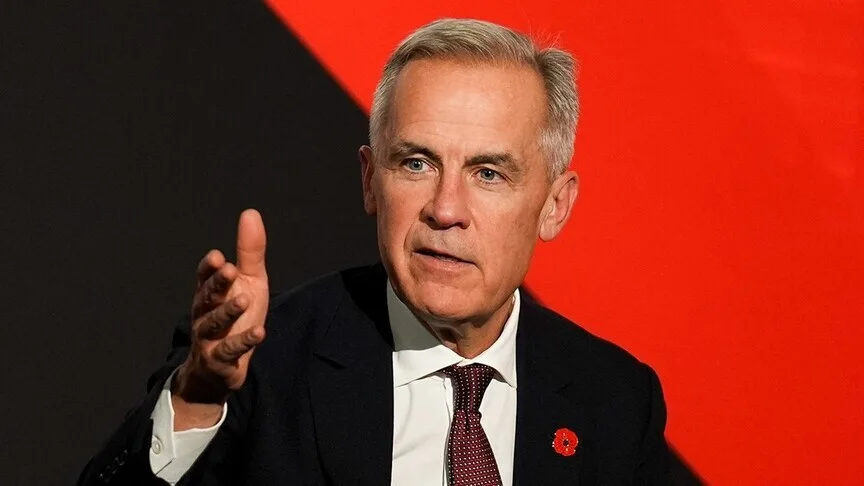
Canada Prime Minister Mark Carney announced the "AI for All" national artificial intelligence strategy on June 4, 2026, in Toronto. The plan aims to reduce Canada’s reliance on foreign AI infrastructure and suppliers while fostering job creation and economic growth domestically [1, 2, 3].
Carney warned Canada faces risks from foreign entities accessing Canadian data and deploying AI products that do not reflect Canadian values. He said, "We are highly dependent on foreign suppliers for the infrastructure that powers AI, from compute to cloud to data storage, that creates real risks that foreign entities could access Canadian data, deploy AI products that shape Canadian lives without reflecting our values, and tilt the playing field against Canadian firms." He added, "AI could be weaponised against us," and stressed the need for sovereign control over AI technology [1, 3].
The strategy targets up to 90,000 new AI-related jobs and work placements for young Canadians. It also aims to create 250,000 AI jobs and generate an additional CAN$200 billion in economic growth over the next five years [2, 3]. To achieve this, the government will invest CAN$500 million in the Regional AI Initiative and CAN$700 million in the AI Compute Access Fund to improve access to domestic computing resources [3].
A CAN$500 million Canadian Tech Growth Fund will take equity stakes in promising AI startups to boost the domestic innovation ecosystem [3]. The government plans to build a public AI supercomputer and expand Canadian-owned cloud and computing infrastructure aligned with clean energy principles [2, 3].
The strategy emphasizes improving AI adoption among Canadian businesses and increasing AI literacy by providing free, entry-level training programs. Every post-secondary student in Canada will gain access to trusted AI agents, helping to build digital skills nationwide [1, 2].
Legislative updates will strengthen protections against harms such as deepfakes and surveillance pricing. The plan also sets up an online safety regime for social media and chatbot users and expands the AI Safety Institute to monitor emerging risks [2, 3].
Carney said, "Prosperity and sovereignty in the age of AI belong to those nations that can build, adopt and govern AI on their own terms," stressing Canada's need to accelerate AI adoption as it remains one of the slowest G7 countries to do so [1, 3].
The Canadian AI startup Cohere recently acquired German firm Aleph Alpha, creating a combined entity valued at approximately US$20 billion with dual headquarters in Toronto and Berlin [1].
The government’s next steps include rolling out training programs and finalizing the AI Compute Access Fund investments to support domestic AI infrastructure.