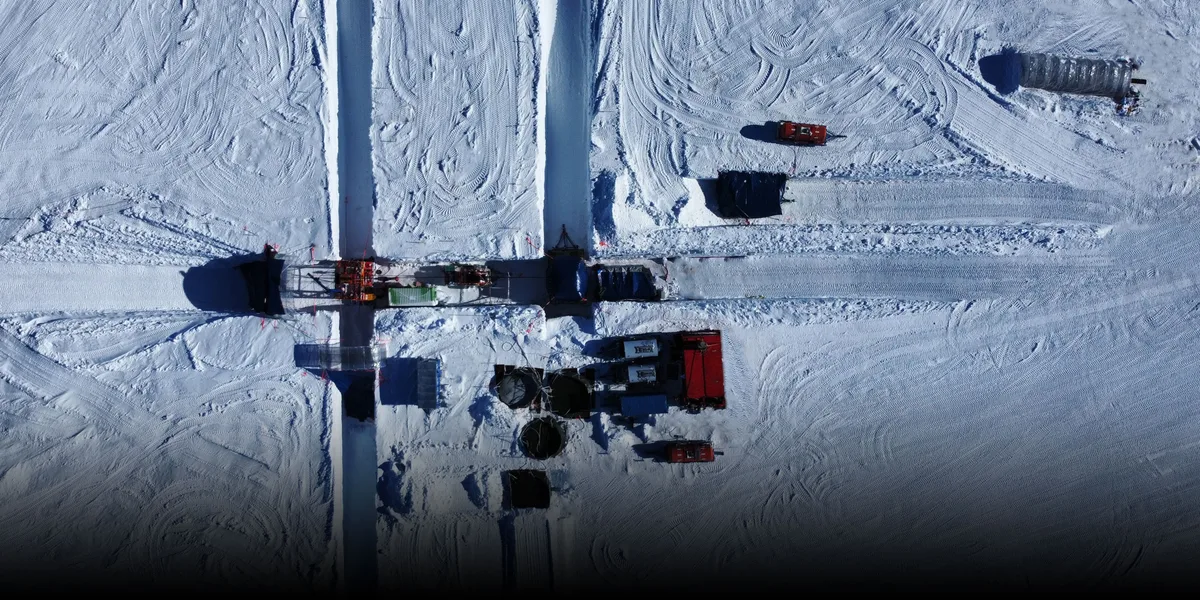
China completed its first hot-water drilling test in East Antarctica during the 42nd Chinese Antarctic Expedition on February 5, reaching a depth of 3,413 meters, surpassing the previous international record of 2,540 meters [1].
The expedition departed Shanghai in November 2025 and was organized by the Ministry of Natural Resources [1]. The mission was jointly led by the Polar Research Institute of China, Jilin University, and China University of Geosciences, with planning from Sun Youhong at the Chinese Academy of Engineering [1].
The drilling penetrated the ice sheet above the Qilin Subglacial Lake, aiming to enable future sampling and observations of water and sediment beneath the ice sheet [1]. Hot water drilling was chosen because it can penetrate more deeply and efficiently than mechanical drilling, while minimizing disturbance to the environment and allowing access to subglacial lakes [1].
China achieved key technological breakthroughs in low-temperature resistance for the hot water drill and controlling contamination during the operation [1]. Guo Jingxue, a team member, said, "Before drilling began, we didn’t dare set a goal of reaching beyond 3,000 meters. But our team was determined. If there was even a 1% chance (that we would succeed), we would give 100% effort" [1].
The deep drilling will aid research into Earth’s paleoenvironment, climate change, sediment formation, and biological evolution in extreme Antarctic lake conditions [1]. The operation marks a major advance in drilling technology and polar research capabilities.
The expedition’s success sets a new benchmark for hot-water drilling depth and lays the groundwork for scientific sampling in one of Antarctica’s least explored subglacial environments [1].