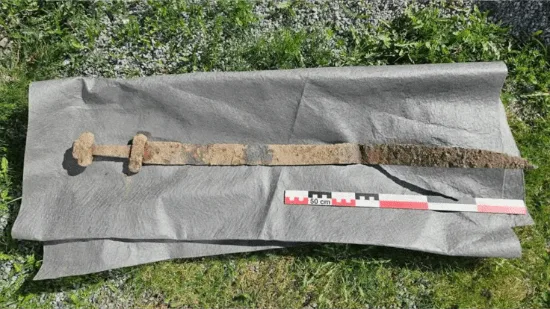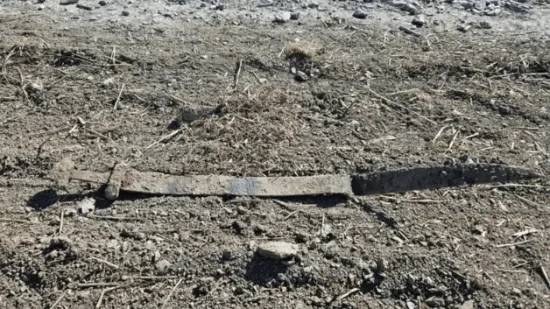
A 6-year-old boy named Henrik Refsnes Mørtvedt found a rusty, single-edged iron sword embedded in soil near Brandbu and Hadeland in Innlandet county, Norway, during a school outdoor excursion in May 2026 [1, 2, 3, 4, 5]. The sword dates back roughly 1,300 years to the late Merovingian Period between 550 and 880 AD, just before the Viking Age began [1, 2, 3, 4, 5]. Experts identified the weapon as a scramasax-type short sword, commonly used in Scandinavia prior to the widespread adoption of double-edged Viking swords [1, 2, 3, 4, 5].
When Henrik spotted the sword partly protruding from the field, his teachers and school staff promptly alerted local archaeologists instead of attempting to remove the artifact themselves [1, 2, 3, 4, 5]. Archaeologists confirmed the find's significance as a rare historical item and transported the sword to the Museum of Cultural History in Oslo for preservation, detailed study, and restoration [1, 2, 3, 4, 5].
Local experts believe the sword may have belonged to a warrior or wealthy farmer, suggesting it was owned by someone of notable status in early medieval Norway [3, 4]. The discovery site in Hadeland is well known for its rich archaeological record including Iron Age and Bronze Age remains [1, 2, 3, 4, 5].
A spokesperson relayed praise for the young finder and the adults present, stating, "We are super proud of the children who managed to see the sword in the field. Well done! And we are very happy that they did everything right: They called an archaeologist." [2]
The sword will undergo further conservation and analysis at the Oslo museum to learn more about its provenance and the era it represents [1, 2, 3, 4, 5].