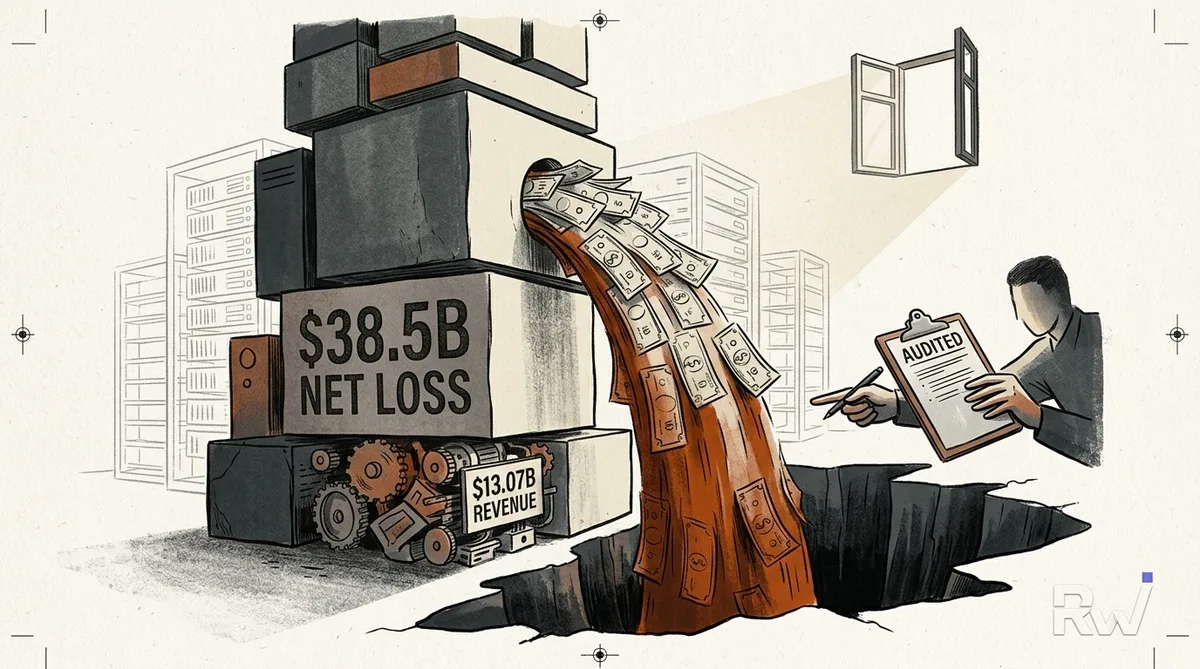
OpenAI's total expenditures for 2025 reached approximately $34 billion, driven by $19 billion in research and development and $6 billion in sales and marketing costs [1, 2, 3, 4, 5]. The company generated around $13 billion in revenue that year, with monthly revenue hitting $2 billion by the end of 2025 [1, 3, 5]. Despite this, OpenAI posted a net loss of $38.53 billion, which included accounting losses related to convertible interests [1]. It also reported an operating loss of about $20.92 billion for 2025 [1]. Excluding non-cash items such as stock-based compensation and restructuring costs, operational losses were estimated at $8 billion [3, 5].
In the first quarter of 2026, OpenAI burned through $3.7 billion in cash, exceeding half its $5.7 billion revenue for the period [6, 7, 8, 9]. However, its cash and securities holdings soared to over $73 billion at quarter-end, up from $40 billion in December 2025 after a major funding round [6, 8]. In March 2026, OpenAI closed a $122 billion financing round valuing the company at $852 billion, with investors including Amazon, Nvidia, SoftBank and Microsoft [1, 5].
On June 8, 2026, OpenAI confidentially submitted a draft S-1 registration statement for an initial public offering to the U.S. Securities and Exchange Commission [1]. The expected IPO could occur around autumn 2026, with a valuation potentially exceeding $1 trillion [7, 5, 9]. CEO Sam Altman said, "There are many factors that could bring the timing of the IPO earlier or later, but filing now allows the company flexibility; if we want to go public sooner, we have options" [9].
Ahead of the expected IPO, OpenAI has implemented internal cost controls, shelving expensive projects such as the video generation tool Sora to improve profitability [5]. The company continues to focus on revenue growth and cash preservation as it prepares for a possible public listing later this year.