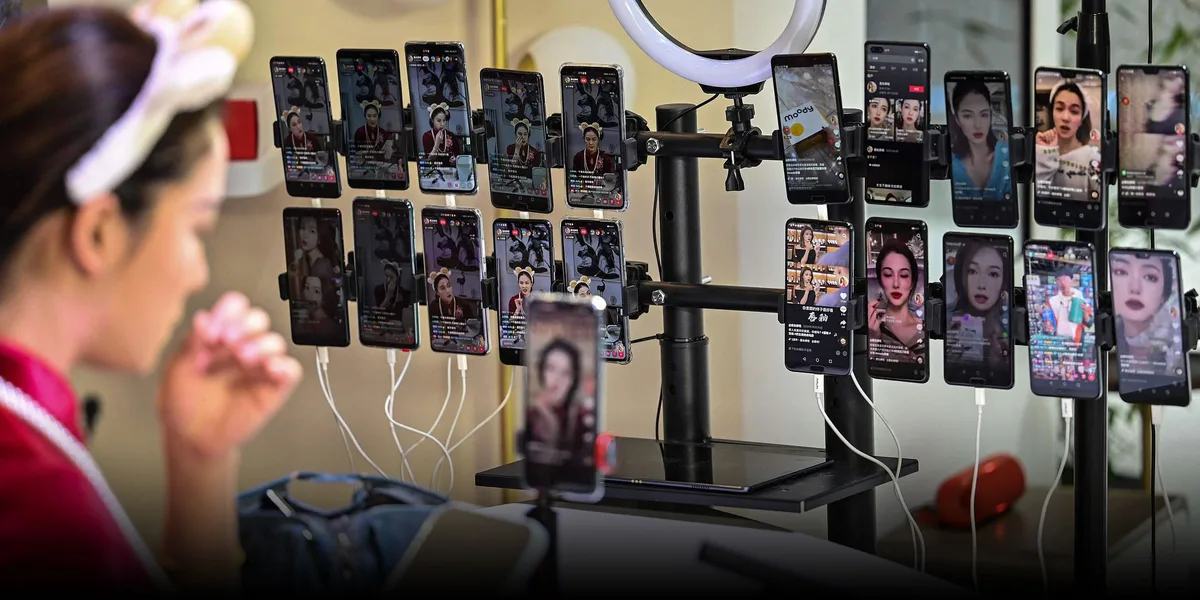
A new report details China’s creator economy as a trillion-yuan market where livestreaming alone accounts for nearly one-third of all online shopping sales [1]. The shift toward short video and livestreaming as central parts of online life took hold in the early 2020s, supplanting earlier personal blogs and experimental videos from a decade ago [1]. Platforms like Douyin, Kuaishou, and Xiaohongshu use algorithms to direct traffic and link content closely to e-commerce [1].
The number of creator accounts has soared to 1.6 billion competing for users’ attention across China’s internet [1]. Although livestream e-commerce saw rapid growth of 41% in 2023, that rate slowed to a projected 16% last year [1].
Wu Jieying, 27, exemplifies this trend with her family-focused videos and advertisements. She films everyday conversations featuring her grandfather and mother mostly in single takes, but remarks that scripted brand introductions take multiple attempts — "two to three takes with my mother, five to seven with my grandfather," she said [1]. Wu’s grandfather acknowledges how unfamiliar the format is to his generation, saying, "People our age don’t understand this" and adding with a touch of humor, "I’ve barely even seen snow" [1].
The economy’s roots trace back a decade when creators were mostly personal bloggers and early influencers experimenting with video [1]. Today, recommended short videos and interactive livestreams are key drivers of consumption.
The report’s timeline underlines these shifts: from experimental beginnings a decade ago, to the centrality of short video and livestreaming platforms by the early 2020s, followed by the boom in livestream e-commerce with 41% growth in 2023, then a slowdown to 16% growth last year [1].
The next major benchmark will be further data releases on livestream commerce performance to track if growth stabilizes or pivots again.