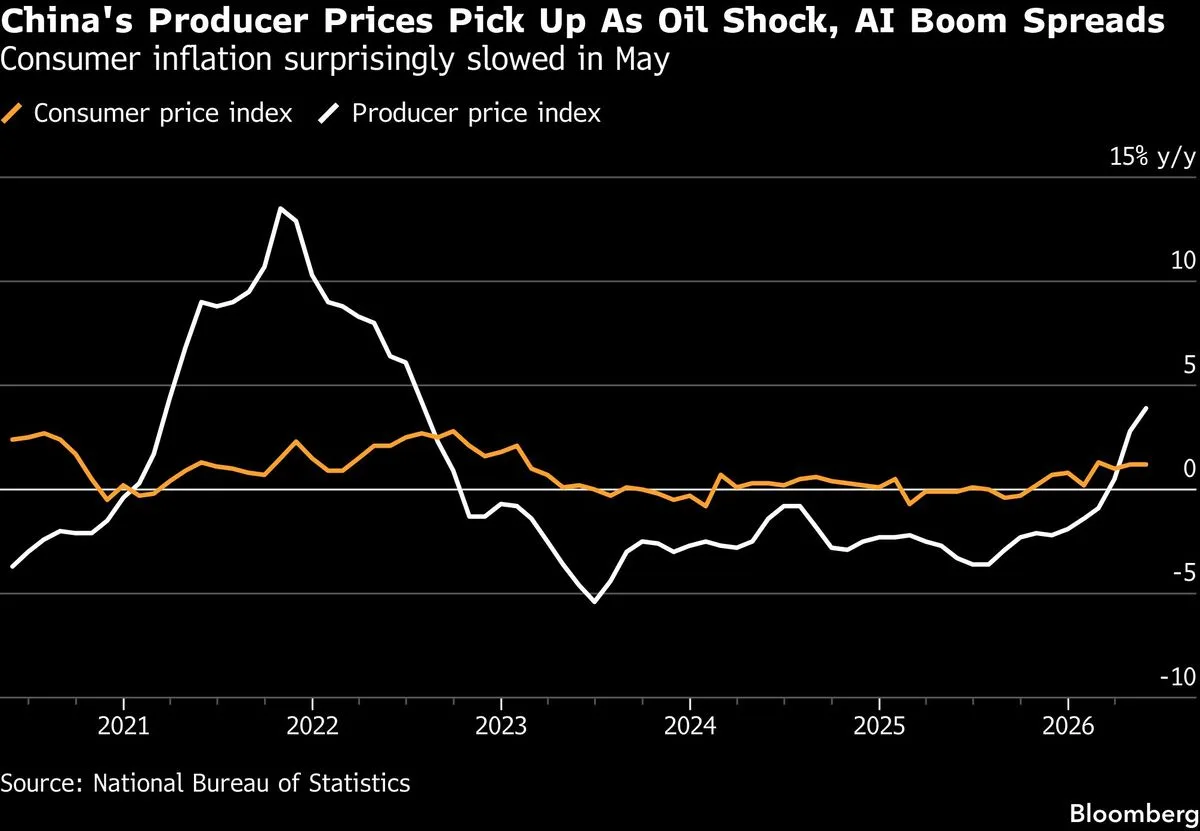
China's producer price index (PPI) jumped 3.9% year-on-year in May 2026, marking the fastest increase since July 2022. The rise was driven by higher commodity and energy costs linked to the Iran war and growing demand for artificial intelligence (AI) technology, according to official data released today [1, 2, 3, 4, 5].
Dong Lijuan, a statistician at China's National Bureau of Statistics, said: "The acceleration of electrification, the deep integration of artificial intelligence across various sectors, and the growing demand for computing power have driven up prices in industries such as nonferrous metals, electrical machinery, and computers" [1]. The rise in producer prices also reflected strong demand for nonferrous metals, electrical machinery, computer chips, and printed circuit boards linked to AI investment [1, 3].
After three years of deflation, China's PPI returned to growth in early 2026 following declines of 3% in 2023, 2.2% in 2024, and 2.6% in 2025. It fell 1.4% and 0.9% in January and February 2026 respectively before rising 0.5% in March, 2.8% in April, and surging 3.9% in May [5].
By contrast, China's consumer price index (CPI) rose just 1.2% year-on-year in May, unchanged from April and below economists' expectations of 1.3% to 1.4% [1, 2, 3, 4, 5]. A sharp 16% plunge in pork prices dragged the CPI down by about 0.3 percentage points, limiting overall inflation [1, 4]. Core CPI, which excludes volatile food and energy prices, increased 1.1% in May, slightly slower than April's 1.2% [1, 3, 4].
HSBC Bank's chief Asia economist Frederic Neumann noted that "consumers in China are keeping a tight fist around their hard-earned renminbi," explaining the muted consumer inflation despite rising producer costs [3].
China's export value surged 19.4% year-on-year in May in US dollar terms, its strongest three-month jump, supported by demand for AI and renewable energy-related goods [1, 3]. Meanwhile, China's crude oil imports have fallen nearly 20% since the Iran war began, helping to cap global oil price rises [3].
Chinese government bond yields remained steady after the inflation data release, with 10-year yields approximately at 1.7% [1]. The next inflation data release is expected in June, which will further reveal how producer price gains affect consumer inflation.