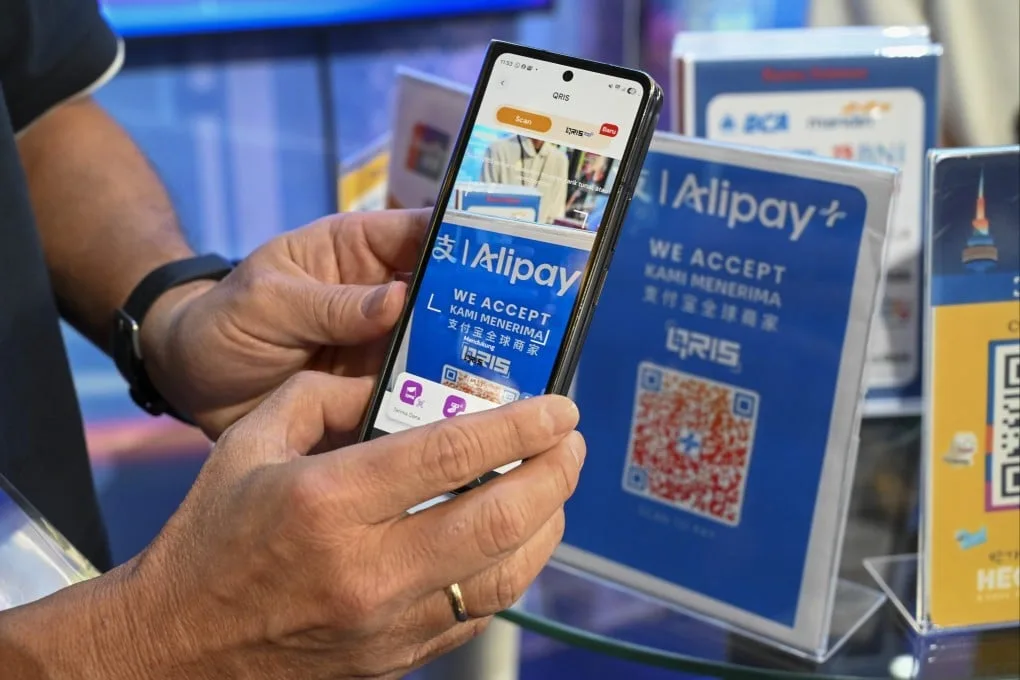
China and Indonesia started a new initiative enabling consumers to use their domestic mobile payment apps to scan QR codes and pay for retail goods in each other's countries using their home currencies, yuan and rupiah respectively [1]. The system includes China's Alipay and Indonesia's QRIS apps [1].
The launch supports Beijing's efforts to expand regional financial connections. Alicia Garcia-Herrero, a Natixis economist, said the initiative’s key goals are to reduce transaction costs and currency risks while advancing dedollarisation, promoting wider use of the yuan, and strengthening ties with important ASEAN partners amid geopolitical drives for financial autonomy [1]. "For Beijing, the primary drivers appear to be advancing dedollarisation efforts, promoting the international use of the yuan and strengthening economic integration with key Asean partners amid broader geopolitical pushes for financial autonomy," Garcia-Herrero said [1].
Similar cross-border digital payment arrangements have already been established between China and several ASEAN countries. In late October, Chinese visitors in Thailand could pay merchants in yuan using their domestic wallets like Alipay [1]. By December, Vietnam allowed visitors to pay through UnionPay, with an expansion last month that added Alipay [1]. Meanwhile, Malaysia and Singapore also have comparable digital payment links with China [1].
Garcia-Herrero expects Beijing will introduce more such payment arrangements with other ASEAN members and international partners this year [1]. This new China-Indonesia system is the latest step toward integrating regional digital payments and boosting yuan internationalisation.
The system is now operational, allowing travelers and consumers in both countries to make payments seamlessly using their regular apps without currency exchanges at physical points of sale. Further expansions to other countries in the region are anticipated as Beijing continues promoting its financial and currency initiatives within ASEAN and beyond [1].